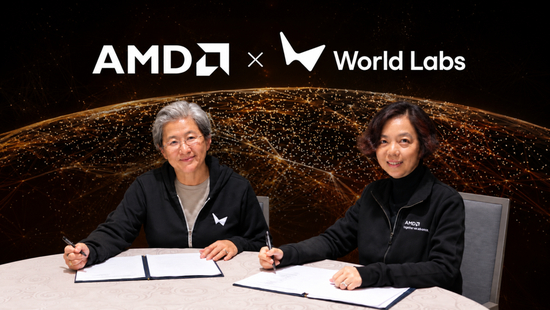
AMD announced on September 28, 2026 at 16:05 (UTC-4) that it has entered into a definitive agreement to acquire World Labs, the San Francisco-based spatial-intelligence AI lab led by AI pioneer Dr. Fei-Fei Li, in an all-stock transaction valued at approximately $8.2 billion. The deal is expected to close by the end of 2026, subject to regulatory approvals.
The deal
Following the close, Dr. Li will join AMD as executive vice president and chief scientist, reporting directly to AMD chair and CEO Dr. Lisa Su. Justin Johnson and Ben Mildenhall, World Labs' co-founders, will continue leading the team alongside Li, forming what the companies describe as a world-leading frontier research organization.
"Building the compute platforms for the next generation of AI requires a deep understanding of how models are evolving," Su said in the announcement. "Fei-Fei and the World Labs team bring exceptional research leadership and model expertise."
Li, whose career includes the ImageNet work from her Stanford lab, serving as chief scientist of Google Cloud's AI unit, and founding Stanford's Human-Centered AI Institute, founded World Labs at the beginning of 2024 with the belief that language alone is not sufficient for model development.
What World Labs brings
World Labs develops spatial-intelligence models that generate, reconstruct, and simulate interactive 3D environments from text, image, and video inputs, as well as technology for robotic learning and simulation.
On September 1, 2026 (UTC), the lab introduced Atlas, which it describes as an omni world model pretrained from scratch as a multimodal autoregressive diffusion transformer operating natively on text, images, video, and 3D. Atlas handles:
- Camera-controlled generation of up to one minute of video at 1440p resolution
- Spatial reconstruction from one to dozens of input images
- Space-time simulation
- Image and 360-panorama generation
World Labs reported that in its own evaluations, Atlas outperformed recent video models at camera-controlled generation and specialized open-source models at 3D reconstruction. Atlas is entering early access with select partners and will power future versions of the company's Marble product.
The lab also acquired SceniX to build toward robotics simulation capability.
Why it matters
This acquisition is about more than AMD buying a model lab — it's about a chipmaker trying to define the hardware needs of the next era of AI before its competitors do. As AI expands into reasoning, robotics, simulation, and physical AI, the demands on compute infrastructure become more diverse. World Labs' expertise gives AMD deeper insight into how workloads are evolving and helps shape its future technology roadmaps.
The $8.2 billion price tag is striking for a two-year-old startup, but it reflects the strategic value of having frontier model research in-house. NVIDIA's $129 billion acquisition of Hugging Face earlier this year sent a clear signal: chip giants are buying their way into the model layer to ensure their hardware is optimized for the models that matter. AMD's move is a direct response.
The partnership isn't new — World Labs began a deep technical collaboration with AMD in 2025, starting with model training and inference optimization on AMD GPUs. Su was also an early investor in World Labs. The acquisition formalizes a relationship that was already working.
The competitive picture
| Company | Acquisition | Value | Focus |
|---|---|---|---|
| AMD | World Labs | $8.2B | Spatial intelligence, world models, physical AI |
| NVIDIA | Hugging Face | $129B | Open-source model ecosystem, developer platform |
| AMD | Taalas | Undisclosed | AI inference optimization (Aug 2026) |
AMD is clearly building a portfolio of AI acquisitions to close the gap with NVIDIA. The question is whether model-level insight will translate into hardware advantage — historically, chip design cycles are long, and model architectures can shift quickly.
Critical thinking
There are real risks here. World Labs' Atlas benchmarks are self-reported, not independently verified. The all-stock structure means AMD is using its own equity, which could dilute shareholders if the integration doesn't pay off. And regulatory approval isn't guaranteed — consolidation in the AI chip sector is drawing scrutiny on both sides of the Atlantic.
But the strategic logic is sound. If physical AI and robotics are the next big wave, having a world model team in-house gives AMD a seat at the table when those workloads are being defined. The alternative — waiting for the market to mature and then optimizing for someone else's architecture — is the position AMD has been trying to escape.
What to watch
- Whether the deal clears regulatory review by end of 2026
- How quickly World Labs' Atlas model appears in AMD's developer tools and ROCm ecosystem
- Whether NVIDIA responds with its own spatial intelligence acquisition
- The first AMD hardware designed with World Labs workloads in mind
Sources: AMD official press release, Fortune, Unite.AI, World Labs "To Seek a Newer World" blog post.
No comments yet