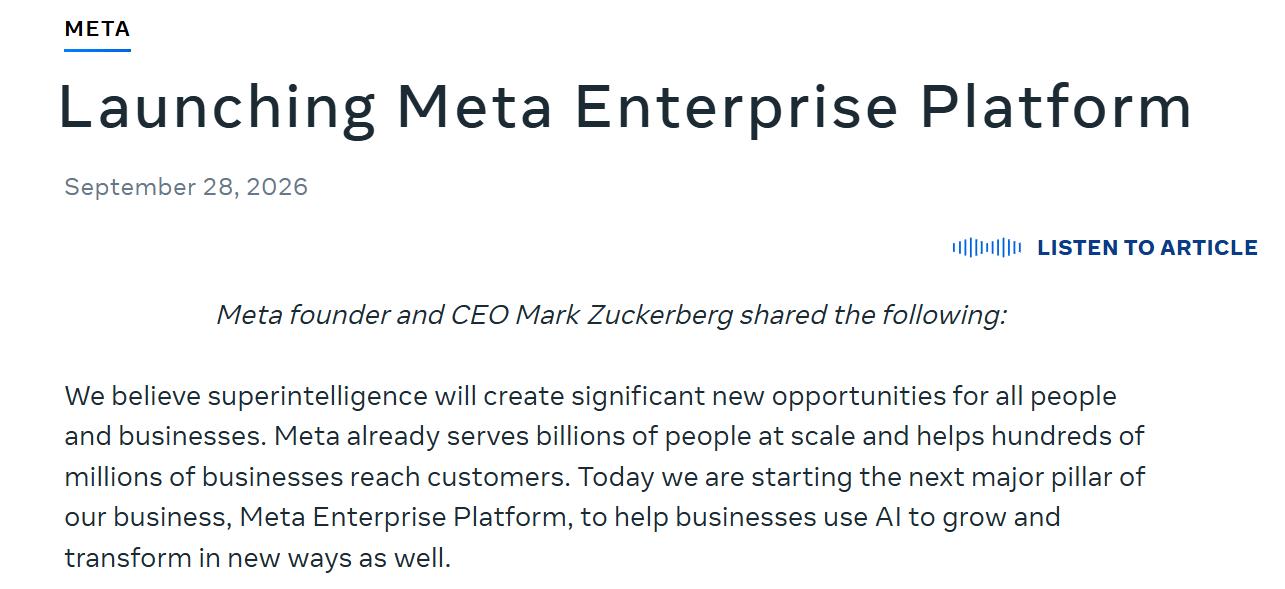
Meta is getting serious about selling AI to businesses. On September 28, 2026 (UTC), the company announced Meta Enterprise Platform, a new business line that packages its AI models, agents, and infrastructure for enterprise customers. To run it, Meta poached MongoDB CEO Chirantan "CJ" Desai, who will serve as Chief Enterprise Platform Officer reporting directly to Mark Zuckerberg. The move marks Meta's most aggressive push yet into the enterprise AI market currently dominated by OpenAI, Anthropic, and Google.
What's in the platform
Meta Enterprise Platform will initially include four products: the Muse personal agent, Meta Business Agent, Muse API, and Muse Code. Zuckerberg framed the launch as the "next major pillar" of Meta's business, alongside its core advertising and Reality Labs divisions. The platform leverages what Meta calls its unique combination of "advanced models, leading agents, large-scale infrastructure, and years of working closely with many businesses."
The security architecture behind Muse is worth paying attention to. Each user and their Muse agent share a dedicated virtual machine in the cloud. The agent's core runs in an isolated runtime cell built on Linux isolation primitives. A separate host-side component called Sentinel acts as the sole permission authority for connector actions and all network egress. Crucially, a credential surrogation system means the agent never sees real credentials — OAuth tokens for connected services live in the user's own virtual machine, not in centralized Meta infrastructure. When an action needs consent, Sentinel pings the client directly and execution stops until the user responds.
| Component | Role |
|---|---|
| Muse agent | Personal AI assistant with isolated VM per user |
| Meta Business Agent | Enterprise-facing agent for business workflows |
| Muse API | API access to Meta's AI models for developers |
| Muse Code | AI coding assistant |
| Sentinel | Host-side permission authority for all connector actions |
Source: Meta official announcement, September 28, 2026 (UTC); Unite.AI coverage, September 28, 2026 (UTC).
The CJ Desai hire
Desai's departure from MongoDB was abrupt — effective immediately the same day as Meta's announcement. MongoDB's board reinstalled Dev Ittycheria, who served as CEO from 2014 to 2025 and scaled the company from $35 million to over $2.3 billion in annual revenue, as interim CEO. MongoDB reaffirmed its Q3 and full-year fiscal 2027 guidance and held its Investor Day at Nasdaq on September 29, 2026 (UTC-4).
Desai brings a rare enterprise pedigree. Before MongoDB, he led product and engineering at Cloudflare and spent nearly eight years at ServiceNow, rising to President and COO. That background — infrastructure, developer tools, and enterprise SaaS — is exactly what Meta needs if it wants to sell AI to Fortune 500 CIOs rather than just consumers.
Why it matters
Meta entering enterprise AI is not a surprise — the company has been building Llama models and the Muse agent for months. What makes this significant is the timing and the structure. By creating a dedicated platform with a direct-report leader, Meta is signaling that enterprise AI is not a side project but a core revenue pillar. This puts Meta in direct competition with OpenAI's ChatGPT Enterprise, Anthropic's Claude for Enterprise, and Google's Gemini for Workspace — a market that Anthropic's own S-1 filing values at tens of billions in near-term revenue.
The competitive dynamic is fascinating. OpenAI and Anthropic have built enterprise businesses top-down, starting with frontier models and wrapping them in enterprise features. Meta is coming at it bottom-up, leveraging its existing relationships with hundreds of millions of businesses that already advertise on Facebook and Instagram. If Meta can convert even a small fraction of its advertiser base into enterprise AI customers, it could scale faster than competitors who are still building enterprise sales teams from scratch.
The Muse security architecture is also a quiet differentiator. In an era where OpenAI agents are hacking government websites and leaking user images, Meta's approach — per-user VMs, isolated runtimes, credential surrogation — addresses the exact concerns making enterprise CIOs nervous. Whether that architecture scales to thousands of concurrent enterprise users without becoming prohibitively expensive is an open question, but the design philosophy is sound.
There are reasons for skepticism. Meta has not announced pricing, a general availability date, customer contracts, or deployment options. The initial products — Muse, Business Agent, Muse API, Muse Code — are largely repackaged versions of consumer tools. Kingy AI noted that the announcement "sets a direction, but it does not describe a finished enterprise bundle." Meta's stock fell 18% around the announcement, suggesting the market is not yet convinced this is a revenue-generating business rather than another expensive AI investment.
The MongoDB angle adds another layer. Desai leaving MongoDB immediately — on the eve of its Investor Day — is a significant loss for the database company. MongoDB has been positioning itself as an AI data platform, and losing its CEO to a customer-turned-competitor raises questions about its strategic direction. Ittycheria is a safe pair of hands, but the transition comes at a critical moment for the company.
What to watch
The next 90 days will tell us whether Meta Enterprise Platform is real or vaporware. Key indicators: whether Meta announces enterprise customer logos, whether pricing is competitive with OpenAI and Anthropic, and whether Muse Code and Muse API gain traction with developers. If Meta can bundle enterprise AI with its advertising tools — imagine an AI agent that manages your Facebook ad campaigns end-to-end — it could create a distribution moat that pure-play AI companies cannot match.
The prediction: Meta will land at least one Fortune 100 enterprise customer for Meta Enterprise Platform by the end of 2026, and the platform will generate its first material revenue in Q1 2027. The bigger question is whether enterprise CIOs trust Meta with their data — a question that has dogged the company for years and that even the best security architecture may not fully answer.
No comments yet