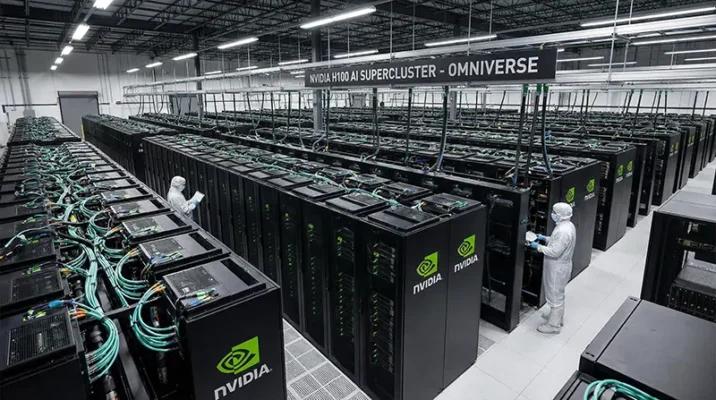
Elon Musk's SpaceX is raising $40 billion to buy Nvidia chips — and it's not for rockets.
According to a report by the Financial Times on October 6, 2026 (UTC), SpaceX is in advanced talks for a funding round led by Apollo Global Management that would inject $40 billion into the company specifically to purchase Nvidia AI accelerators. The move marks the most aggressive bet yet by a non-traditional tech player on AI compute infrastructure, and it signals that the AI infrastructure arms race has spread well beyond the usual suspects of hyperscalers and model labs.
The deal
The $40 billion round, led by Apollo, is earmarked for Nvidia chip purchases to power SpaceX's rapidly growing AI compute business. SpaceX has been quietly building an AI hosting operation alongside its rocket and satellite divisions, and the scale of the ambition is staggering.
SpaceX CFO Bret Johnsen recently disclosed that newly signed AI compute hosting agreements will generate approximately $1.1 billion in additional monthly revenue. The company has set a target of reaching $100 billion in annual recurring revenue (ARR) by the end of 2026 — a figure that would make its AI division alone larger than most enterprise software companies.
The company plans to deploy 2 gigawatts of ground-based compute capacity by the end of 2026, with the first orbital compute satellites scheduled for launch in 2027. That orbital compute vision — running AI workloads on satellites in low Earth orbit — is uniquely SpaceX, leveraging its Starlink constellation and launch capability in a way no other company can replicate.
Why Nvidia, why now
| Company | Recent AI chip spend | Compute capacity target |
|---|---|---|
| SpaceX | $40B (proposed) | 2 GW by end of 2026 |
| xAI (Musk) | ~$50B (Colossus cluster) | 100K+ H100s deployed |
| Microsoft | ~$80B/year (capex) | Undisclosed, multi-region |
| Amazon | ~$100B/year (capex) | Trainium + Nvidia |
| ~$75B/year (capex) | TPU v8 + Nvidia |
Sources: Financial Times, company disclosures, industry estimates
Nvidia is the obvious beneficiary. The company's market capitalization reached $5.86 trillion on October 6, 2026 (UTC), within striking distance of $6 trillion. Morgan Stanley estimates that Nvidia has locked up approximately 37.3% of global high-bandwidth memory (HBM) supply for 2027, with long-term supply commitments rising from $119 billion to $279 billion in a single quarter. The company projects 70% revenue growth in fiscal 2028, well above the market's prior expectation of 45%.
For SpaceX, buying Nvidia is the pragmatic choice. The company needs proven, high-volume accelerators that can be deployed at scale quickly. Custom silicon — the route taken by Google (TPU), Amazon (Trainium), and Microsoft (Maia) — requires years of design and software ecosystem work. SpaceX doesn't have that time, and Nvidia's CUDA ecosystem remains the path of least resistance for AI workloads.
Why it matters
This deal is about more than one company buying chips. It represents a structural shift in who is building AI infrastructure. Historically, AI compute has been the domain of hyperscalers — Amazon, Microsoft, Google — and a handful of AI startups like xAI and OpenAI. SpaceX entering the arena with a $40 billion commitment changes the competitive landscape.
The orbital compute angle is the truly novel part. If SpaceX can run AI inference workloads on satellites, it creates a compute topology that doesn't exist today: low-latency, globally distributed processing that doesn't depend on terrestrial data centers. For applications like autonomous vehicles, drone navigation, and real-time satellite imagery analysis, compute in orbit could be faster than bouncing signals to a ground station and back.
The financial math is also worth examining. $40 billion in chip purchases against a target of $100 billion ARR implies a roughly 2.5x revenue-to-capital ratio — aggressive but not unreasonable for AI hosting, where utilization rates and pricing power have been strong. If SpaceX hits its $1.1 billion monthly revenue run rate from new contracts alone, that's $13.2 billion in annual revenue before the new capacity even comes online.
Critical lens
There are reasons for skepticism. SpaceX's AI business is still nascent, and the $100 billion ARR target is ambitious for a division that was barely discussed a year ago. The company has a history of setting aggressive timelines — Starship development, Starlink deployment — and while it often delivers, the gap between announcement and execution can be years.
The concentration risk is also significant. SpaceX would be joining xAI as the second Musk-led company making massive Nvidia bets. Combined, Musk's AI ambitions now span two publicly relevant entities, both dependent on the same chip supplier, both competing for the same limited HBM and foundry capacity. If Nvidia's supply chain hits a bottleneck — and Morgan Stanley's HBM lockup data suggests bottlenecks are coming — both companies could be constrained simultaneously.
The Apollo-led structure is also telling. This is private credit and equity, not a traditional venture round. Apollo is a distressed-debt specialist moving into AI infrastructure financing, which suggests the market sees these chip purchases as asset-backed investments with predictable cash flows from hosting contracts. That's a maturation of the AI compute financing model — but it also means SpaceX is taking on leverage that must be serviced regardless of whether AI demand materializes as projected.
What to watch
- Closing timeline: When does the $40 billion round actually close, and are there conditions or tranches tied to deployment milestones?
- Chip type: Will this be H100/H200 inventory or the newer Blackwell B200/B300 generation? The answer determines real-world performance per dollar.
- Hosting customers: Who is signing the $1.1 billion/month in new contracts? Enterprise AI labs, government agencies, or model providers?
- Orbital compute timeline: The 2027 satellite launch target is the most ambitious claim. Watch for test payload announcements in the first half of 2027.
- Nvidia supply: With 37.3% of 2027 HBM already locked, can SpaceX actually take delivery of $40 billion worth of chips on schedule, or will allocation be spread over multiple years?
- Competitive response: Will Amazon, Microsoft, or Google respond with their own accelerated capex, or does SpaceX's entry validate the market rather than threaten it?
SpaceX's $40 billion Nvidia bet is the clearest signal yet that AI compute has become a strategic infrastructure category — one that companies with unique physical assets (rockets, satellites, spectrum) are entering not as customers, but as competitors. The era of AI compute being owned by a handful of hyperscalers may be ending. Whether SpaceX can execute on its orbital vision is the question that will determine whether this looks like a masterstroke or an overextension in 18 months.
No comments yet