SpaceX just posted its first quarterly profit as a public company — and the engine driving it isn't rockets or satellite internet. It's AI.
The company reported Q3 2026 earnings on October 20, 2026, after market close, with a conference call at 16:30 (UTC-4). Total revenue hit $14.6 billion, up 161% year-over-year. Net income was $4.4 billion, a $5.5 billion swing from a $1.1 billion loss a year ago. The stock jumped over 8% in after-hours trading.
The headline number everyone is talking about: SpaceX's Super Intelligence (SI) segment — which houses xAI, Grok, X advertising, and the Cursor acquisition — generated $7.56 billion in revenue. That's 52% of the company's total. It's more than Starlink ($5.25B). It's more than four times the entire space launch business ($1.77B). And it grew 830% year-over-year.
The numbers behind the inflection
| Metric | Q3 2026 | Q3 2025 | YoY Change |
|---|---|---|---|
| Total revenue | $14.575B | $5.576B | +161% |
| SI (AI) revenue | $7.560B | $0.813B | +830% |
| Connectivity (Starlink) revenue | $5.248B | $3.097B | +69% |
| Space revenue | $1.767B | $1.666B | +6% |
| Net income | $4.404B | -$1.054B | first profit |
| SI Adjusted EBITDA | $4.953B | -$0.428B | turned profitable |
| SI capex | $16.444B | $4.760B | +245% |
| Nameplate compute | 1.7 GW | 0.6 GW | +183% |
Source: SpaceX Q3 2026 earnings release
The SI segment itself breaks down into two pieces. SI solutions & infrastructure — essentially leasing data center capacity to third-party AI developers — brought in $7.02 billion, up from just $359 million a year ago. Advertising (X's ad business) contributed $538 million, up 18% YoY.
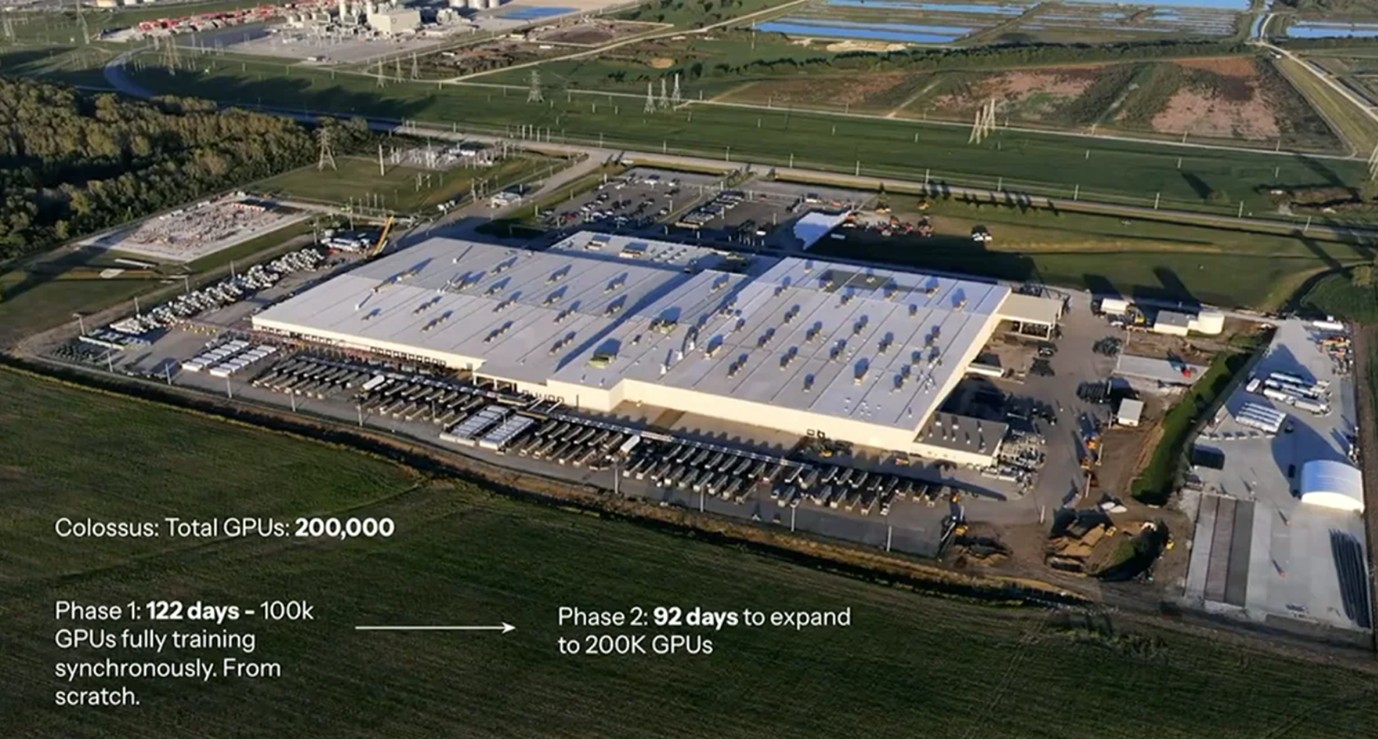
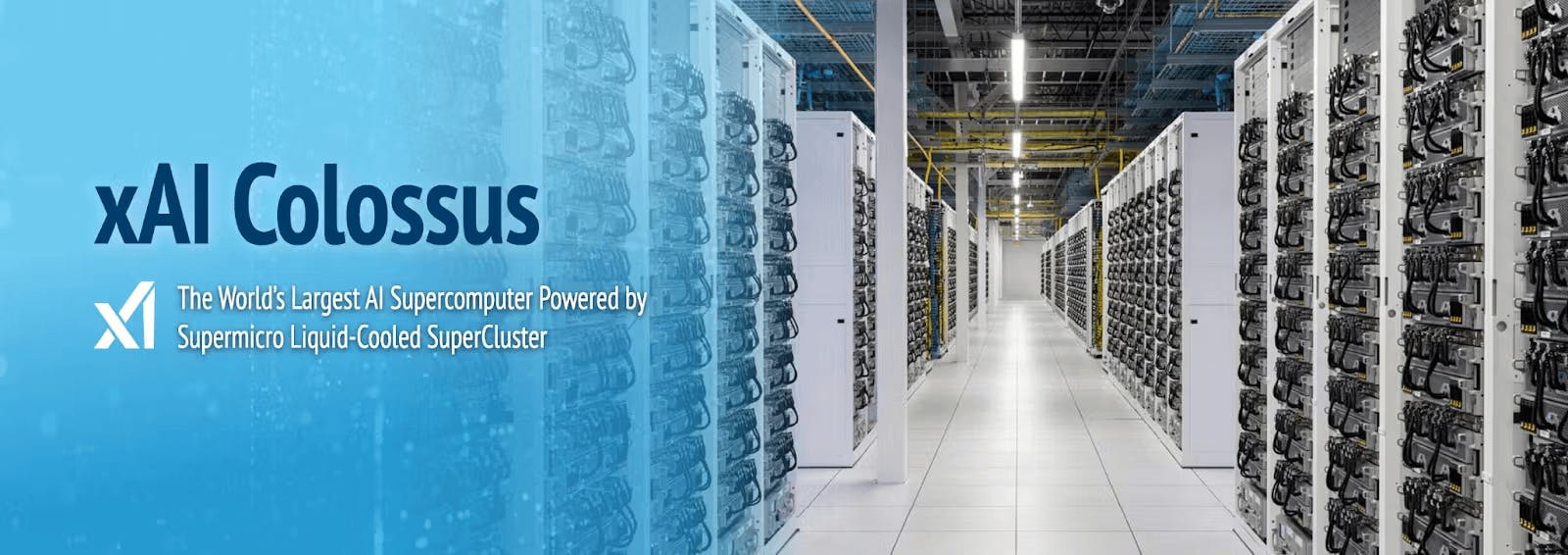
That split is the real story. The vast majority of SpaceX's AI revenue doesn't come from Grok subscriptions or Cursor subscriptions. It comes from renting out GPUs — the COLOSSUS II data center buildout in Memphis — to other AI companies. Chinese media reports name Anthropic, Google, and Reflection AI as customers, and SpaceX's own release says it "signed additional cloud services agreements during the quarter, increasing our pipeline of critical SI infrastructure capacity for third-party customers."
In other words, SpaceX is quietly becoming one of the world's largest AI cloud providers.
Cursor's contribution
The Cursor acquisition, completed on August 14, 2026 at an implied equity value of $60 billion, added $608 million in revenue in just the ~1.5 months from closing to September 30. Annualized, that's roughly $4.8 billion — making Cursor one of the fastest-growing software products in history, if the run rate holds.
But the acquisition came with a massive stock-based compensation bill. SpaceX recorded $1.2 billion in share-based compensation from Cursor in Q3 alone, which is why SI operating income came in at only $431 million despite $4.95 billion in Adjusted EBITDA. The total value of equity awards issued to retain Cursor's team is $23.4 billion, vesting over time — a staggering retention package that underscores how strategically important SpaceX considers Cursor's engineering talent.
The compute arms race
SpaceX's nameplate compute capacity reached 1.7 gigawatts as of September 30, up from 1.4 GW in Q2 and 0.6 GW a year ago. For context, that's enough electricity to power roughly 1.3 million American homes. And the company spent $16.4 billion on SI capex in a single quarter — more than double the entire segment's revenue.
This is the tension at the heart of the story. SpaceX's AI business is now profitable on an EBITDA basis, but it's burning enormous amounts of capital to build out capacity. The nine-month SI capex total is $40 billion. Whether that investment generates adequate returns depends entirely on whether demand for AI compute keeps growing at current rates — and whether SpaceX can keep winning cloud services contracts away from AWS, Azure, and Google Cloud.
Why it matters
This earnings report marks a structural shift in how we should think about SpaceX. For years, the narrative was "rocket company with a satellite internet side business." Now the company's largest and fastest-growing segment is AI infrastructure, and it's not close.
Three implications stand out.
For the AI industry, SpaceX's emergence as a major compute lessor changes the cloud landscape. AWS, Azure, and Google Cloud have dominated AI infrastructure, but SpaceX is building capacity at a pace the hyperscalers are struggling to match — 1.7 GW and growing, with $16.4B in quarterly capex. If Anthropic and Google are already renting SpaceX capacity, that tells you the incumbents can't meet demand on their own. A fourth major AI cloud provider is materializing, and it's vertically integrated with its own models (Grok), its own developer tool (Cursor), and its own power/land pipeline.
For investors, the first quarterly profit answers a question that has hung over SpaceX since its June 2026 IPO: can this company ever make money? The answer, at least for now, is yes — but the profitability is fragile. SI operating income of $431M disappears if you strip out the one-time benefit of cloud contract activations, and the $16.4B quarterly capex means free cash flow is still deeply negative. The market is rewarding the revenue inflection, but the unit economics of AI compute leasing haven't been tested in a downturn.
For the competitive landscape, the Cursor numbers should alarm every other AI coding tool. $608M in 1.5 months implies a revenue run rate that dwarfs GitHub Copilot, Replit, and every other competitor. If SpaceX can bundle Cursor with Grok models and its own compute infrastructure — a fully integrated developer stack — it could become the default platform for AI-assisted coding, and the $60B acquisition price starts to look cheap.
A critical look
A few caveats temper the enthusiasm. The $7.02B in "SI solutions & infrastructure" revenue is heavily concentrated in a small number of large cloud contracts. If one major customer (say, Anthropic) shifts capacity back to its own data centers or to a competitor, the revenue impact would be severe. SpaceX doesn't disclose customer concentration, but the nature of AI compute leasing — few buyers, massive contracts — makes it inherently lumpy.
The advertising business, meanwhile, grew only 18% YoY to $538M. For a segment that was supposed to be the revenue backbone of X, that's sluggish. X's ad business remains a fraction of what Twitter was at its peak, and there's no indication in these numbers that the platform is winning back major brand advertisers.
And the Grok model itself gets barely a mention in the earnings release beyond "accelerated Grok model release deployment" and the introduction of Grok Bot. There are no user numbers, no revenue figures, no benchmark scores. For a company that spent billions building Colossus to train AI models, the model business appears to be an afterthought next to the compute leasing business. That's either a deliberate strategic choice — infrastructure is higher-margin and more defensible — or an admission that Grok hasn't achieved the product-market fit of ChatGPT or Claude.
What to watch next
- Q4 SI capex: If it exceeds $20B, SpaceX is on track for $60B+ in annual AI infrastructure spending — a number that would make it the largest AI infrastructure investor on Earth.
- Cursor Q4 revenue: The first full quarter of Cursor ownership. If it clears $1.2B (implying acceleration from the $608M partial quarter), the $60B acquisition looks prescient.
- Cloud customer disclosures: Watch for named partnerships in future earnings. A confirmed multi-year deal with a major AI lab would validate the compute-leasing model.
- Grok monetization: At some point SpaceX needs to show that Grok generates real revenue beyond X Premium subscriptions. If 2027 passes without a standalone Grok revenue line, the model business is effectively a loss leader for compute leasing.
- Compute utilization: 1.7 GW nameplate capacity is meaningless if it's sitting idle. Watch for commentary on utilization rates and average selling price per GPU-hour in the Q4 call.
SpaceX started the year as a rocket company with an AI side project. It ends Q3 as an AI infrastructure company that also launches rockets. Whether that pivot sustains profitability through the massive capex cycle is the question that will define the stock — and the AI cloud market — over the next 12 months.
Sources: SpaceX Q3 2026 earnings release (ir.spacex.com), SpaceX investor presentation, MadRobot.blog, Businesskorea, Sina Finance, 21st Century Business Herald.
No comments yet