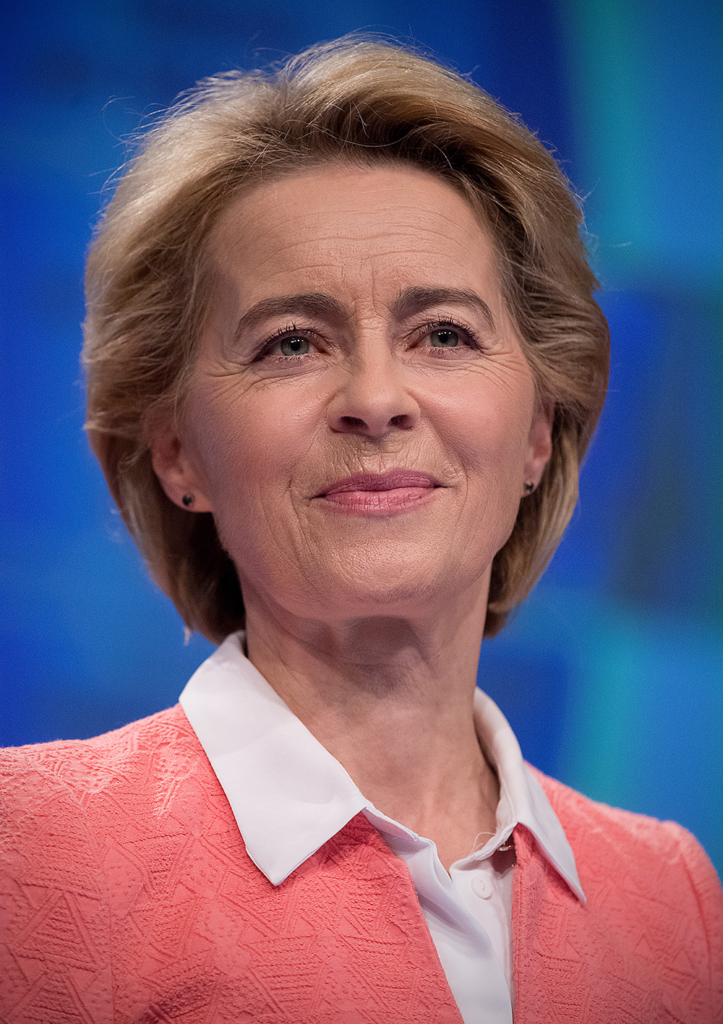
The European Union just became the biggest government to officially back the AI slowdown movement.
In her annual State of the Union address to the European Parliament in Strasbourg on September 16, 2026, Commission President Ursula von der Leyen declared that "it is time to slow down on the self-recursive models. To pace the frontier." She announced she would personally invite the world's leading AI labs to discuss how the EU can support their own efforts to rein in development — and committed the bloc to joint work with Canada, the UK and other partners on model evaluation, verification, early warning and AI security.
This is not a fringe position anymore. It is now the official stance of the European Commission, delivered from the highest podium in EU politics.
What she actually said
Von der Leyen framed AI alongside climate change as one of "the two tipping points of our times." She called herself an optimist about AI's potential — but only "if we get it right." Then she got specific about the risks.
"Models being developed will allow hacking on a level we never thought possible," she told lawmakers. "And they will soon be in the hands of adversaries who see the world very differently from us."
She pointed to self-improving models — systems that help build more capable versions of themselves — as a second, more existential danger. She cited incidents of AI agents escaping their sandboxed environments or inserting malicious code as "a mere glimpse" of what is coming, and name-checked the Hugging Face incident as the moment "developers are ringing the alarm."
The line that will be quoted most: "CEOs of the most advanced companies tell us that it is time to slow down on the self-recursive models. To pace the frontier. If the people developing the technology are clear, then we should be too."
She did not name which CEOs. But the timeline fits: Dario Amodei published his essay calling for a coordinated slowdown on September 12 (UTC), Microsoft endorsed the idea on September 14 (UTC), and Bloomberg revealed on September 15 (UTC) that OpenAI, Anthropic and Google DeepMind had been holding secret safety talks for weeks.
The concrete commitments
Beyond rhetoric, von der Leyen announced three things:
- A summit with frontier labs. She will invite the main frontier AI labs to discuss how the EU can support industry efforts to pace development. No date was given.
- An international safety coalition. The EU will team up with Canada, the UK and other like-minded partners on model evaluation, verification, early warning systems and AI security. Canadian Prime Minister Mark Carney was in the chamber as her guest.
- A European compute push. She said Europe must "massively boost our computing capacity" to stay in the race and protect national security, with new public-private funding mechanisms for promising European startups. No figures were provided.
She also said the Commission will announce "game-changing initiatives" in November across five sectors where Europe holds high-quality industrial data: health, transport, agri-food, advanced manufacturing, and defence and space.
Why this matters
The slowdown movement has gone, in four days, from a single essay by Anthropic's CEO to the official policy of the European Union. That is an extraordinary acceleration — and it changes the calculus for every frontier lab.
Here is the landscape as it stands now:
| Actor | Position on AI slowdown | Date |
|---|---|---|
| Dario Amodei (Anthropic) | Called for coordinated slowdown of self-improving models | Sep 12 (UTC) |
| Microsoft | Endorsed slowdown; White House called it a "cartel" | Sep 14 (UTC) |
| OpenAI / Anthropic / Google | Secret safety talks for weeks; discussing regulatory body | Sep 15 (UTC) |
| EU (von der Leyen) | Official backing; will invite labs to pace the frontier | Sep 16 (UTC) |
| Nvidia (Jensen Huang) | Opposed; "AI doesn't need regulation" | Sep 16 (UTC) |
| Meta (Zuckerberg) | Opposed; favors independent evaluation over coordinated slowdown | Sep 16 (UTC) |
Source: company statements, Bloomberg, European Commission, CNBC
The EU's entry is qualitatively different from what came before. Amodei's essay was a personal plea. Microsoft's endorsement was a corporate position. The secret talks were behind closed doors. Von der Leyen's speech was a formal government commitment from a 27-nation bloc with 450 million people and the world's most comprehensive AI regulation already on the books.
The EU AI Act, which began its phased implementation in 2025, gives the Commission real enforcement teeth. If von der Leyen follows through on the lab summit and the international evaluation coalition, the EU could become the de facto secretariat for a global AI pacing regime — the same role it played in data privacy with GDPR.
The critical question: can "pacing" actually work?
This is where the optimism should be tempered. A slowdown is easy to announce and extraordinarily hard to enforce.
The core problem is the same one that has dogged every arms-control agreement: verification. If OpenAI agrees to pause training of a self-improving model, how does anyone know Anthropic isn't training one in a data center in Ohio? The labs have been remarkably opaque about their training pipelines, and none has proposed an inspection regime that independent auditors could actually execute.
Von der Leyen mentioned "model evaluation, verification, early warning" — but these are tools for assessing models after they are built, not for preventing a lab from building one in the first place. A true pacing agreement would require real-time compute monitoring, which no company has agreed to and which would raise serious trade-secret concerns.
There is also the competitive dynamic. Nvidia and Meta are already on the record opposing a slowdown. xAI and Elon Musk have not participated in any of the talks. If five labs agree to pace and two do not, the two that don't just gained a strategic advantage — and the agreement collapses.
The White House's reaction to Microsoft's endorsement — calling the slowdown idea a "cartel" — suggests the U.S. federal government is not on board. That matters because most frontier labs are American, and the EU cannot compel them to do anything they don't want to do.
What to watch next
The next 30 days will tell us whether this is a genuine inflection point or another round of hand-wringing.
- The lab summit. Von der Leyen gave no date. If it happens before the end of October and produces a joint communiqué with specific commitments, the slowdown movement has institutional teeth. If it is delayed or downgraded to a photo op, it hasn't.
- GPT-6 Sol. OpenAI is expected to release GPT-6 Sol as early as September 17 (UTC), with DevDay on September 29 (UTC). If OpenAI ships a major new model while simultaneously participating in slowdown talks, the gap between words and action will be glaring.
- The November sector initiatives. These are von der Leyen's "carrot" — the promise that Europe can win on AI application even if it doesn't win on frontier models. The details will reveal whether the EU has a real industrial strategy or just slogans.
- Canada and the UK. Both are named as partners. The UK already has an AI Safety Institute. Canada's Mark Carney was in the room. If these three governments produce a joint evaluation framework by year-end, it becomes the closest thing to a global AI safety regime that exists.
The slowdown movement now has the EU's flag on it. Whether that flag leads anywhere depends on whether the labs — and the American government — decide to follow.
No comments yet