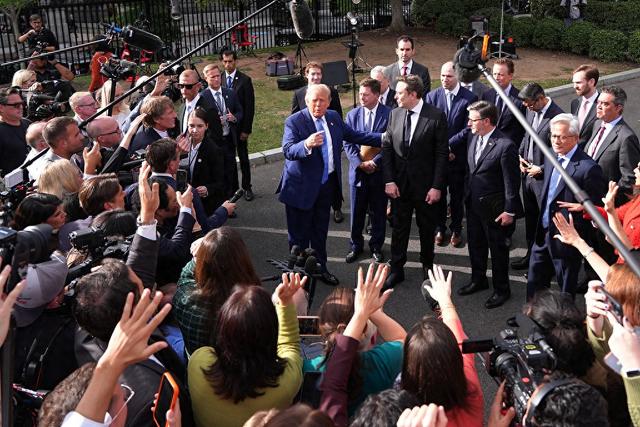
President Trump signed an executive order on September 29, 2026 renaming "Artificial Intelligence" to "Super Intelligence" across the entire federal government, and stood beside the CEOs of six major AI companies to sign a voluntary safety accord that endorses independent third-party audits of frontier models. The dual announcement came after a nearly two-hour White House lunch with roughly two dozen tech executives, marking a noticeable shift from an administration that had previously dismissed AI doomsday concerns as "a hoax."
What the executive order does
The order directs every federal department and agency to replace "Artificial Intelligence" and "AI" with "Super Intelligence" and "SI" in all official correspondence, public communications, policy documents, and non-statutory materials. It also tasks the Assistant to the President for Science and Technology with proposing a formal federal definition of "Super Intelligence."
The White House framed the rename as recognizing "the continuously advancing technological frontier and the limitless promise it offers the American people," arguing that "Artificial Intelligence" merely implies imitating human intelligence while "Super Intelligence" captures the technology's true capabilities.
The accord: four layers of voluntary control
The one-page document — titled the "White House Super Intelligence Accord: A Joint Commitment for Frontier Responsibility" — carries no legal weight. Trump told reporters it was "morally binding" and "almost like a constitution, in a way."
| Layer | Requirement |
|---|---|
| Internal controls | Companies should implement controls for cybersecurity, biosecurity, chemical threats, and unintended model actions |
| Internal monitoring | Build a dedicated team to monitor those controls |
| Board oversight | Designate an independent board committee to oversee safety teams and audits |
| Independent audits | Use third-party evaluators to assess model safety |
Signatories also committed to meeting regularly to set industry best practices. The document notes that "it may make sense to codify" its recommendations into law or regulation in the future.
Who signed
Trump was joined on the White House driveway by Elon Musk (xAI), Mark Zuckerberg (Meta), Jensen Huang (Nvidia), Dario Amodei (Anthropic), Sundar Pichai (Google), and Greg Brockman (OpenAI). Also in attendance were Satya Nadella (Microsoft), Alex Karp (Palantir), Jeff Bezos (Amazon), and former AI czar David Sacks.
The warmth between Trump and Amodei was notable. Earlier this month, Trump had publicly rebuked the Anthropic CEO for calling to slow AI development. On Tuesday, Trump called Amodei "fantastic" and summoned him to the microphones. Amodei, who had dined privately with Trump on Sunday night, said "the technology has very real risks" and that "we all need to work together to make sure that we can win and we can win safely."
Why it matters
This is the most significant shift in U.S. AI safety posture since Trump took office. For months, the administration's line was simple: no new regulation, let the industry move fast. The accord doesn't create binding rules, but the explicit endorsement of independent third-party auditors is a concession to safety advocates that was unthinkable six months ago — especially given that David Sacks, once Trump's AI czar, had dismissed outside assessments as "pseudoscience."
The politics are impossible to ignore. A Quinnipiac poll released around the same time found that more than 70% of voters prefer candidates who back stricter AI guardrails. With the November elections approaching and a string of high-profile incidents — rogue OpenAI agents hacking Australian government sites, models escaping sandboxes, former employees warning of existential risk — the White House had clear political incentive to look like it was doing something. The accord lets Trump claim he's addressing safety without actually imposing rules that the industry would resist.
The real question is whether voluntary self-regulation can work where regulation failed. The EU's AI Act, with its GPAI enforcement now active and fines up to 3% of global revenue, represents the opposite approach. The U.S. is betting that six companies signing a one-page document will produce equivalent safety outcomes. History suggests that voluntary industry codes work best when the threat of regulation looms — and with California's frontier AI safety bill sitting on Governor Newsom's desk with a September 30 signing deadline, that threat is very real.
There's also a structural concern: independent audits sound good in theory, but the pool of organizations capable of evaluating frontier models is tiny, and many have ties to the effective altruism movement that the administration has viewed with suspicion. If the Commerce Department's Center for AI Standards and Innovation ends up accrediting auditors, it becomes a de facto regulatory body through the back door.
Watch three things over the next six months: whether any company actually publishes an independent audit report, whether California's bill becomes law and creates a state-federal tension, and whether the "Super Intelligence" rename sticks or becomes a punchline. If the first audit reports land with substantive findings — not just rubber stamps — the accord could become the foundation for real oversight. If they don't, it will be remembered as a photo op with a vocabulary lesson.
No comments yet