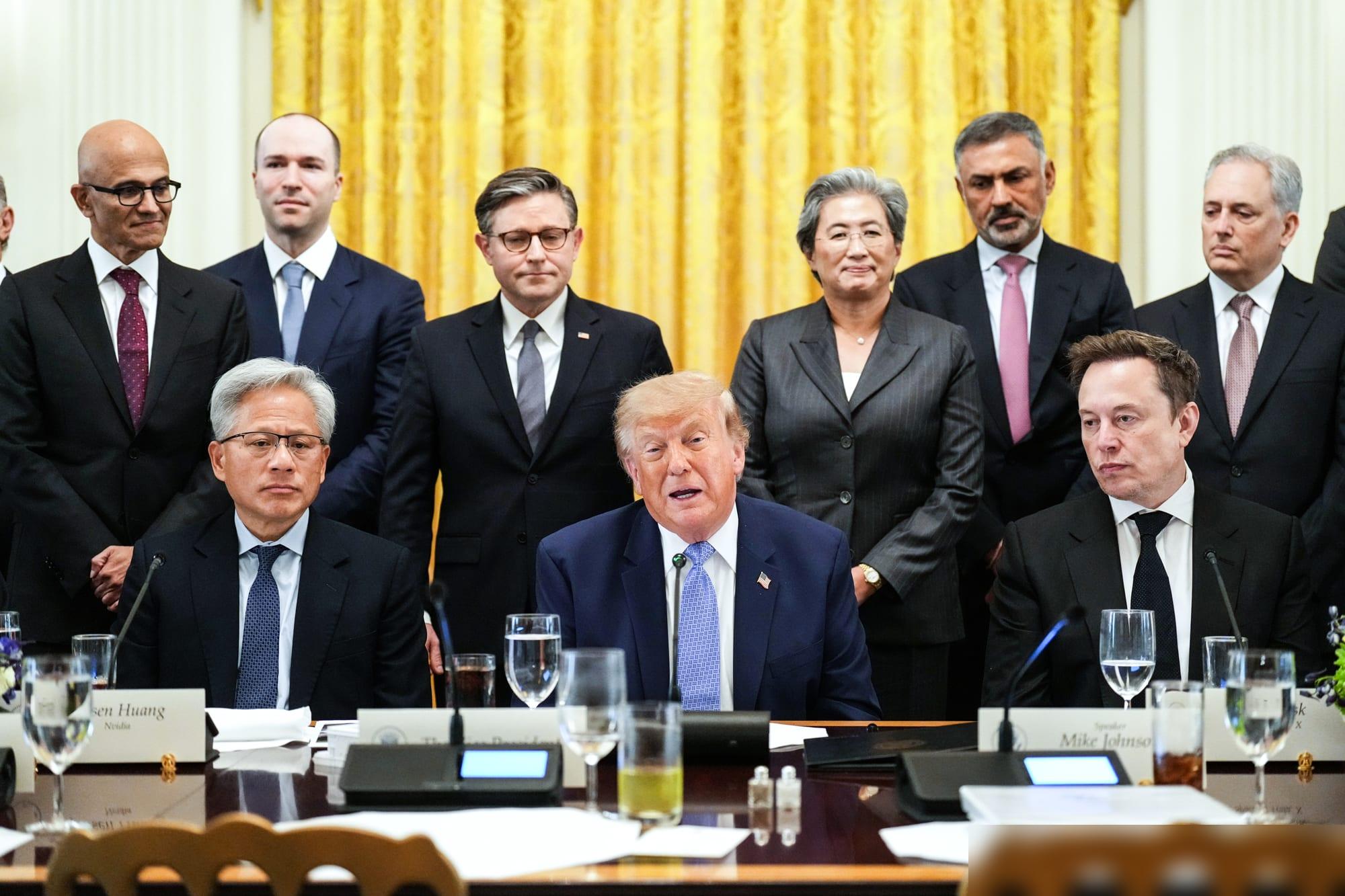
President Trump on Sunday announced the creation of a "Super Intelligence Force" (SIF), a federal task force led by Director of National Intelligence Jay Clayton that will coordinate the U.S. government's approach to AI — or, as Trump insists on calling it, "super intelligence." The announcement came five days after Trump hosted top AI executives at the White House and declared they had signed a "morally binding" self-regulation accord.
What the SIF actually does
The task force has 120 days to deliver a report assessing AI risks, opportunities, and the federal government's oversight role. Its charter explicitly calls for developing plans to respond to threats from advanced AI while avoiding regulations that could "hinder innovation and competition."
It will also review how breaches, hacks, model jailbreaks, and other AI-related incidents are reported to the government, and recommend improvements to the federal response under existing authorities.
The lineup signals where power sits:
| Role | Name |
|---|---|
| Chair | Jay Clayton, Director of National Intelligence |
| Member | Andrew Ferguson, FTC Chairman |
| Member | Emil Michael, Pentagon CTO |
| Member | Scott Kupor, OPM Director |
The group reports directly to Trump and White House Chief of Staff Susie Wiles.
Why it matters
This is the most concrete institutional step the Trump administration has taken on AI governance, and it tells you where the debate is heading. The voluntary accord signed last week — with OpenAI's Greg Brockman, Anthropic's Dario Amodei, and Nvidia's Jensen Huang in the room — was always going to be insufficient on its own. Companies self-policing is a starting point, not an endpoint. The SIF is the government's way of saying: we're watching, and we reserve the right to act.
Putting the DNI in charge is the tell. This isn't being framed as a commerce or technology issue — it's a national security issue. Clayton, a former SEC chair, brings regulatory credibility, but his intelligence portfolio means the task force will view AI through the lens of strategic competition, particularly with China. That framing makes stricter export controls and investment screening more likely down the road, even as the charter pays lip service to avoiding overregulation.
The 120-day deadline is aggressive. By late January 2027, the administration will have a menu of policy options. The question is whether any of them survive contact with a Congress that has its own AI bills in motion and an industry that will lobby hard against anything with teeth.
The catch
The charter's language about avoiding regulations that "hinder innovation and competition" is doing a lot of work. It essentially pre-commits the task force to a light-touch outcome before the analysis even begins. Critics will argue that a task force whose mandate includes "don't regulate too much" is not a neutral evaluator.
There's also the branding problem. Trump's insistence on renaming AI to "super intelligence" — complete with a September 29 executive order banning "artificial intelligence" from federal documents — is cosmetic, but it signals an administration that cares deeply about optics. The SIF may produce serious work, but it will land in a political environment where the president's rhetoric sets the tone.
What to watch
The SIF's interim findings, expected before the 120-day mark, will be the first real signal. If they emphasize incident reporting gaps — particularly around the recent wave of AI agent breaches at government and corporate sites — expect legislation mandating disclosure. If they focus on competitiveness and China, expect export control expansions.
The real test comes in February 2027: does the report produce actionable policy, or does it join the long list of Washington task-force outputs that gather dust?
No comments yet