America's AI companies are quietly switching to Chinese open-source models. What's driving the exodus?
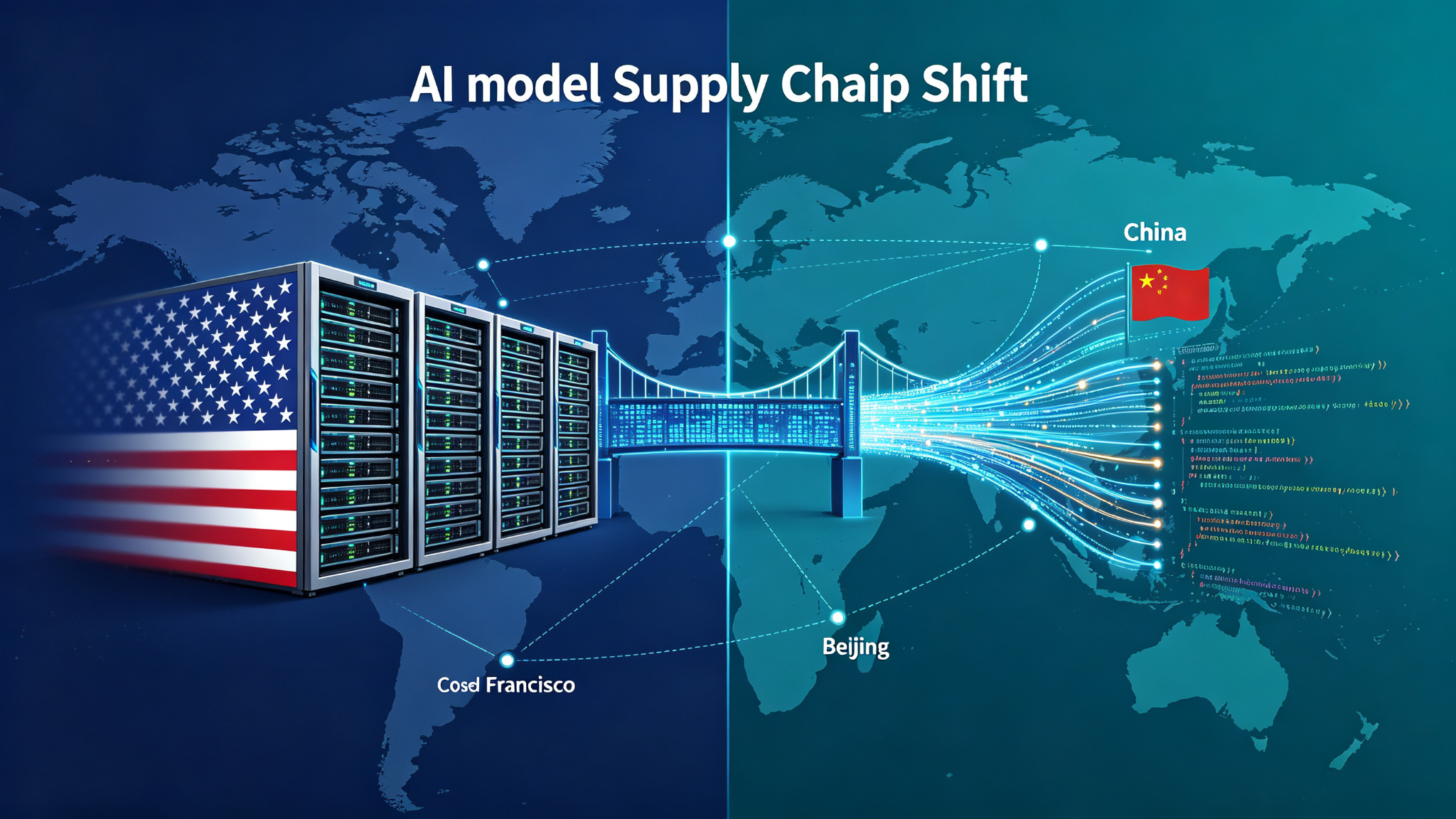
Something big is happening in the AI industry, and most people haven't noticed. The companies building the most expensive AI applications in the world are quietly moving away from American closed-source models — and replacing them with Chinese open-source ones.
Cursor. Harvey. Thomson Reuters. These aren't random startups. They're the biggest names in code, law, and financial intelligence. And one by one, they're taking the foundation of their products off American APIs and putting it on models they can download to their own servers.
The shift didn't happen overnight. It started with a warning shot from Washington.
The kill switch that changed everything
On June 12, 2026, the US Commerce Department sent Anthropic an export control directive. Fable 5 and Mythos 5 — Anthropic's two most powerful models — could no longer be accessed by anyone of foreign nationality. Not even Anthropic's own overseas employees.
Anthropic couldn't verify every user's citizenship in seconds, so it did the only thing it could: took the models offline globally. No warning, no appeal process. Financial firms, healthcare providers, software companies — all lost access to the world's most capable model overnight.
Eighteen days later, the models came back. But with conditions: Anthropic agreed to government review of new model releases, proactive reporting of safety risks, and the Commerce Department reserved the right to pull the plug again at any time.
American media called it a "regulatory kill-switch." In one afternoon, it moved from theory to operational reality.
The message was loud and clear: if your business runs on someone else's API, your business can disappear at the whim of a regulator.
Two switches, one fear
The companies switching to Chinese open-source models are afraid of two switches.
The first is political. Washington just demonstrated how it works.
The second is commercial, and it sits in the hands of the API providers themselves. When you're a company that lives by calling someone else's model, your supplier can raise prices tomorrow, change terms the next day, and launch a competing product the day after — and there's nothing you can do about it.
OpenAI and Anthropic are both moving into vertical industries like law and coding. Harvey, the legal AI company valued at $11 billion, is backed by OpenAI. It knows better than anyone that the supplier it calls every day could eventually become its competitor.
A Thomson Reuters tech executive put it bluntly: calling someone else's model is like renting an apartment. There's a roof, someone does maintenance, it's comfortable. But the place isn't yours. No matter how long you stay, you never build equity. Training your own model is buying a house — bigger upfront cost, but it's yours from day one.
The migration, company by company
Cursor moved first. In March, the coding tool valued at roughly $30 billion released Composer 2, its "self-developed" model. The blog post talked about continued pretraining and reinforcement learning. It didn't mention the base model.
Within 24 hours, developers digging through API logs found a model ID: kimi-k2p5-rl-0317-s515. The prefix was Kimi K2.5. Elon Musk personally retweeted the finding. Moonshot AI pointed out the tokenizer was identical — and nobody had asked for authorization.
Cursor's founder eventually admitted it: after evaluating every base model, Kimi K2.5 was the strongest. The missing attribution was a mistake. Kimi's official account later confirmed it was an authorized partnership through Fireworks. The whole thing ended amicably — but the cat was out of the bag.
Two months later, Cursor released Composer 2.5 and put the base model in the first sentence of the announcement. Same company, two months apart: from hiding to volunteering. The wind changed faster than the models.
Then came the punchline: in June, Musk's SpaceX announced it was acquiring Cursor for $60 billion. The man who personally mocked Cursor for using Kimi ended up buying the company that uses Kimi.
Harvey followed in August. The legal AI platform — backed by OpenAI, serving 2,000+ institutions — released its own model with the base written right in the title. 150 NVIDIA B300 GPUs, two months of training, and it pushed Kimi K3's full-task completion rate on legal work from 10.8% to 19.7%. The cost per task stayed the same as the base model.
For context: OpenAI trained its new flagship on over 100,000 GPUs. An application company got a domain-specialized model with 150 cards. The barrier to switching bases is lower than anyone thought.
Thomson Reuters came last and stayed quietest. In late August, the 150-year-old information company committed $40 million to its own model. It has Westlaw — a legal database so massive it's basically an industry unto itself. The press release said it was built on "strong open-source foundations" but didn't name which one. Before using it, they spent months recalibrating with Imperial College London, turning someone else's base into their own intermediate model. They named it Snowdon.
Money spent, work done, name withheld. That's the real price of sensitivity around attribution.
The numbers behind the shift
On OpenRouter, the model aggregation platform, Chinese models' share of traffic from American companies has climbed steadily this year. Since February, it's been above 30% every week. At its peak, it hit 46%.
The price dynamic is even more interesting. Before August, Chinese models were absurdly cheap — the same task cost a fraction of an American flagship. Then on August 17, DeepSeek raised its flagship output price by 350%. The same week, OpenAI cut its flagship price by 80%. The gap narrowed. Downloads didn't reverse.
Kimi's annualized revenue nearly tripled in three months. The people downloading aren't losing money, and the people charging aren't either.
Why not American open-source?
Three years ago, the open-source model world belonged to Llama. Meta open-sourced it and developers everywhere built on it. That throne has a new occupant now — and the names at the top of the leaderboard have moved from San Francisco to Hangzhou and Beijing.
America hasn't given up. Meta spent the first half of the year keeping its flagship closed and selling it, then reversed course on August 10 when Zuckerberg published a long essay re-embracing open source, releasing a 30B local model and promising flagship weights would follow. OpenAI moved earlier, releasing its first open-source model since GPT-2 last August — 120 billion parameters.
But the open-source rankings are still dominated by Chinese teams.
A German consulting firm partner put it in terms European companies understand: Chinese open-source weights running on local European servers keep data in-house. That's closer to "sovereignty" than calling an American API that can be remotely repriced or withdrawn at any time. Siemens has already integrated Alibaba's model into its industrial software. They're not necessarily pro-China. They just don't want to bet on either side's kill-switch.
The pushback from both sides
Washington noticed first. In late July, Republican Senator Tom Cotton wrote a long letter to the Commerce Secretary. He cited a report claiming nearly 80% of American startups build their applications on Chinese models. He named Airbnb's customer service bot using Alibaba's Qwen, Cursor's coding base being Kimi, and added a national security angle: defense contractors are using Cursor to write software for the Department of War. What if a backdoor is embedded in the weights?
He recommended expanding the ban from DeepSeek to all Chinese models, prohibiting government contractors from using any of them.
The letter is still just a letter. It hasn't become policy.
AT&T, America's largest telecom company, runs 40% of its internal AI queries on NVIDIA's open-source model but publicly says it hasn't touched any Chinese model — DeepSeek and Kimi are still "under risk assessment." Wanting the benefits of open source while avoiding the most capable open-source models: that six-word tension — "want to use, dare not use" — is written across the face of more than a few American enterprises. Microsoft is also evaluating letting DeepSeek handle part of Copilot's workload. Cotton's letter specifically cited this as evidence.
And it's not just Washington. Beijing is reaching for its own switch. The Commerce Ministry is in discussions with Alibaba, ByteDance, and Zhipu about adding model weights to export controls. Nothing has landed yet, but the direction is clear.
At the same time, the EU's new transparency rules took effect. About 190 organizations signed on — Anthropic, OpenAI, Google, Microsoft all included. Not a single Chinese large model company signed. Some outsiders read it as arrogance. The more likely explanation: when your own government's gate is being prepared, who wants to be the first to promise an open door?
Both sides are turning their switches in the same direction.
The Hugging Face factor
On September 3, NVIDIA announced it was acquiring Hugging Face for $12.93 billion — $11.9 billion in cash plus $1 billion in employee incentives. The deal is subject to antitrust review and expected to close in the first half of 2027.
Hugging Face is the home base of AI open-source models. It's the first stop for Chinese models going global — ChatGLM, Qwen, DeepSeek all reached the world through Hugging Face.
The dock changed owners overnight. NVIDIA says it'll stay neutral, anyone can upload, anyone can download. But actions speak louder: back in March, NVIDIA led the creation of an open-source alliance called Nemotron, pulling in Cursor and Thinking Machines to build America's own open-source models.
The irony is thick. Cursor runs on Kimi. Thinking Machines' architecture follows DeepSeek's path. America's open-source counteroffensive is standing on a Chinese foundation.
The free era is ending
After giving away models for so long, someone had to start talking about money. The reasons are legitimate: user growth is too fast, compute is scarce, training and electricity cost real money, shareholders want returns. The free model can't sustain itself forever.
Kimi is in talks with Microsoft, Google, and Amazon about selling its model on their clouds — taking up to a 30% cut. Alibaba is starting to think about charging its heaviest users. Zhipu took a third path: its new license sets a threshold — cloud providers with over $10 billion in annual revenue need to pass a security review before using its models. No money changes hands, but identity is registered.
DeepSeek is still giving everything away under the most permissive open-source license, taking zero revenue share. The vendors who used to hand out free flyers together are starting to charge franchise fees. The weapon of "free" is being half-dismantled by its own side.
Wharton professor Ethan Mollick sees it from a distance: the era of frontier open-weight models probably won't last much longer. Both Washington and Beijing can hear that sentence — one thinks it's been too long, the other thinks it's been too short.
What this means
The AI industry is undergoing a quiet but fundamental reorientation. The assumption that American companies would always build on American models is breaking down. The combination of regulatory risk, commercial dependency, and the sheer quality of Chinese open-source models is pushing even OpenAI-backed companies to diversify.
This isn't about politics. It's about control. When your entire product runs on a model you don't own, you don't own your product. The companies that figured this out first — Cursor, Harvey, Thomson Reuters — are the ones building moats instead of renting apartments.
The question isn't whether the migration continues. It's whether both governments, in reaching for their respective kill-switches, will force the middle ground to collapse entirely — leaving every company to build its own model, or accept that the future of AI is fundamentally multi-polar.
No comments yet