Saudi Arabia just launched its national AI model — and it's built on Chinese open-source weights
On September 3, 2026 at 15:32 UTC, Saudi Arabia did something that would have been unthinkable a year ago. Its sovereign wealth fund unveiled the country's flagship national AI model — and instead of building it on American technology, it built it on open-source weights from a Chinese company.
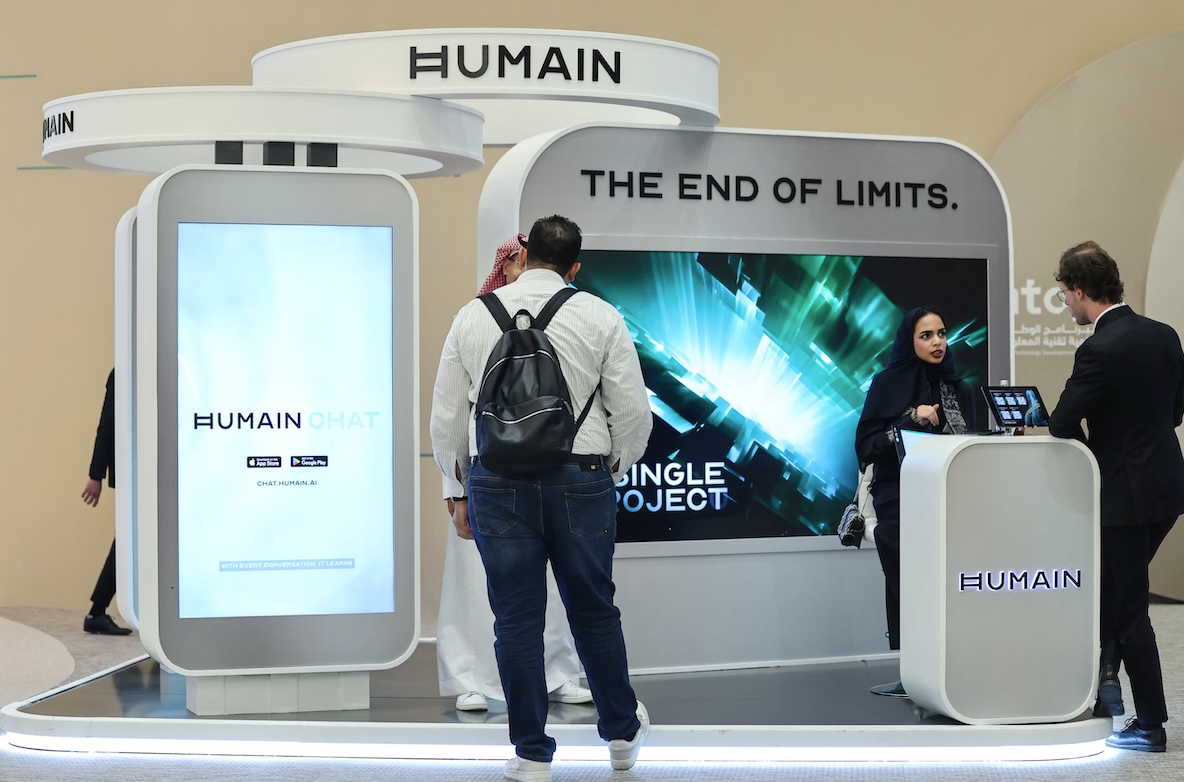
The model is called humain-m3. It was announced at LEAP in Riyadh by HUMAIN, the AI company wholly owned by Saudi Arabia's Public Investment Fund (PIF). And it was delivered by MiniMax, the Chinese AI firm whose open-source M3 model serves as the foundation.
This isn't a minor integration. It's a sovereign nation choosing Chinese open-source AI as the backbone of its national intelligence infrastructure. And the numbers back up the choice.
What humain-m3 actually is
Humain-m3 is a 428-billion-parameter mixture-of-experts (MoE) model. If you're not familiar with MoE, here's the short version: the model has 428 billion parameters total, but only activates about 23 billion per token — so you get the intelligence of a huge model at the running cost of a much smaller one.
It's built directly on the MiniMax-M3 lineage. MiniMax open-sourced M3 back in June, and it's been quietly racking up impressive scores ever since — 59.0% on SWE-Bench Pro (beating GPT-5.5 and Gemini 3.1 Pro), 83.5 on BrowseComp (beating Opus 4.7), with a 1-million-token context window and native multimodal support for text, images, and video.
HUMAIN took that base and poured in over one trillion tokens of Arabic-native content for further pretraining. The result is a model that doesn't just speak Arabic — it was shaped by it from the ground up.
The benchmark numbers that matter
HUMAIN tested humain-m3 across seven public Arabic benchmarks and published the results. The model averaged 89.37% across all seven, beating every frontier model it was compared against.
| Benchmark | What it tests | humain-m3 | GPT-5.6 SOL | Opus 5 | MiniMax M3 (base) |
|---|---|---|---|---|---|
| AlGhafa | Core Arabic understanding | 86.45% | 81.54% | 83.06% | 75.31% |
| ArabicMMLU | Native-Arabic broad knowledge | 90.70% | 88.82% | 88.77% | 81.80% |
| Arabic EXAMS | Academic examinations | 67.67% | 66.40% | 64.80% | 61.27% |
| MadinahQA | Arabic language proficiency | 95.44% | 94.48% | 94.78% | 87.10% |
| AraTrust | Truthfulness and trust | 97.53% | 93.42% | 91.38% | 90.60% |
| ALRAGE | Retrieval-augmented generation | 94.63% | 94.91% | 94.85% | 79.32% |
| Translated MMLU | Translated knowledge | 93.20% | 91.48% | 93.78% | 87.00% |
| Average (equal weight) | Overall | 89.37% | 87.30% | 87.34% | 80.34% |
Source: HUMAIN Node model page, evaluation of preview checkpoint
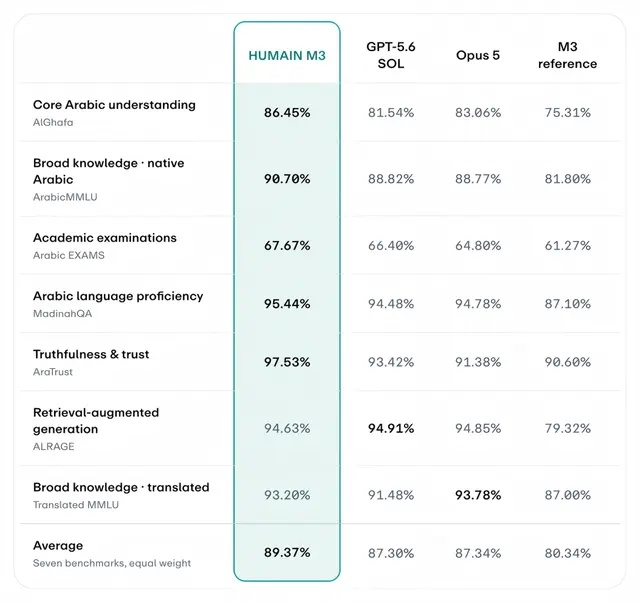
Humain-m3 led five of the seven benchmarks. The Arabic post-training alone added roughly nine points on average over the base MiniMax M3 checkpoint.
To put that in perspective: GPT-5.6 SOL and Opus 5 are two of the most capable models on the planet. And on Arabic, a model built on Chinese open-source weights beat them both.
It's not just about language
The Arabic performance gets the headlines, but humain-m3 inherits the full agentic toolkit from MiniMax M3. It handles frontier tool use and computer use for long-horizon agent workflows — in both Arabic and English. It offers three thinking modes: always-on, adaptive, and off. It was trained jointly on text, image, and video from the first step, with long-video understanding and native screen operation.
That matters because Saudi Arabia isn't just buying a chatbot. It's building infrastructure for government services, healthcare, education, and finance — all of which need models that can take actions, not just answer questions.
How to get it (for now)
Humain-m3 is available in research preview through HUMAIN Node, the company's platform at node.humain.com. You can try it in a no-code playground or call it through an OpenAI-compatible API endpoint.
Access is tiered. A limited-preview tier applies a Saudi alignment guardrail, with thinking and streaming turned off and some added latency. A research-preview tier gives you the full checkpoint with thinking, streaming, and lower latency.
HUMAIN Node already hosts more than 100 frontier, proprietary, and open-source models from various providers, with a single API key and bill across all of them. It offers a choice of global, in-Kingdom, or sovereign hosting — the last option being exactly the kind of data-residency guarantee that American API providers struggle to offer.
And here's the kicker: HUMAIN says it expects to release the model weights under the MiniMax Community License next month, once safety training and alignment are complete. A sovereign national AI model, open-sourced under a Chinese license. That sentence would have been absurd in 2024.
Why Saudi Arabia chose MiniMax
HUMAIN was launched in May 2025 by Saudi Crown Prince Mohammed bin Salman himself, with a mandate to build a full-stack AI company spanning data centers, infrastructure, models, and industry solutions. It already has the ALLAM family of Arabic models. This is a country that takes AI seriously as a matter of national strategy.
So why MiniMax, and not OpenAI or Anthropic?
The answer probably comes down to three things.
Control. MiniMax M3 is open-source. HUMAIN can download the weights, run them on its own servers, modify them, and fine-tune them without asking anyone's permission. That's sovereignty. With an American API provider, you're renting intelligence — and as the June Anthropic export control incident showed, that rental can be terminated at any time.
Performance. MiniMax M3 is genuinely competitive at the frontier. Its coding and agent scores rival the best closed models. For a country building practical AI infrastructure, that matters more than marketing.
Arabic. American models are trained primarily on English. Arabic — spoken by hundreds of millions of people — has always been an afterthought. HUMAIN poured a trillion Arabic tokens into the model because it could, because the weights were open, and because no American provider was going to prioritize that work for them.
HUMAIN CEO Tareq Amin put it simply: "Arabic is spoken by hundreds of millions of people, yet it remains significantly underrepresented at the frontier of artificial intelligence. With humain-m3, we are investing in changing that."
The market noticed
MiniMax is publicly traded in Hong Kong. On September 4, the stock opened up more than 10%, reaching a market cap of approximately 136.1 billion HKD. The reason wasn't just the HUMAIN deal itself — it was what the deal signaled.
If Saudi Arabia, one of the wealthiest and most strategically ambitious countries in the world, chooses Chinese open-source AI for its national model, other countries will notice. The "model export" playbook is changing: it's no longer about selling API access. It's about becoming the foundation that other nations build on.
This is the same dynamic we saw with Cursor, Harvey, and Thomson Reuters switching to Chinese open-source models. The difference is that those were companies. This is a government.
What this means
Humain-m3 is a research preview, not a finished product. The benchmarks are HUMAIN's own evaluation of a preview checkpoint. The open-weight release is still a month away. There's plenty that could change.
But the direction is clear. The frontier of AI is no longer exclusively American. Chinese open-source models are now competitive enough that sovereign nations are choosing them as national infrastructure. And once a country builds its AI stack on open weights, the switching costs go in one direction only.
For the United States, this is a wake-up call. Export controls and API restrictions don't just protect national security — they push customers toward alternatives. And those alternatives are getting good enough that the choice is no longer obvious.
For MiniMax and the Chinese open-source ecosystem, this is validation on a national scale. The company serves over 300 million users and 2 million enterprises across 230+ countries. Now it can add "foundation of Saudi Arabia's national AI" to that list.
For the rest of the world watching — the question isn't whether more countries will follow Saudi Arabia's lead. It's how many, and how fast.
No comments yet