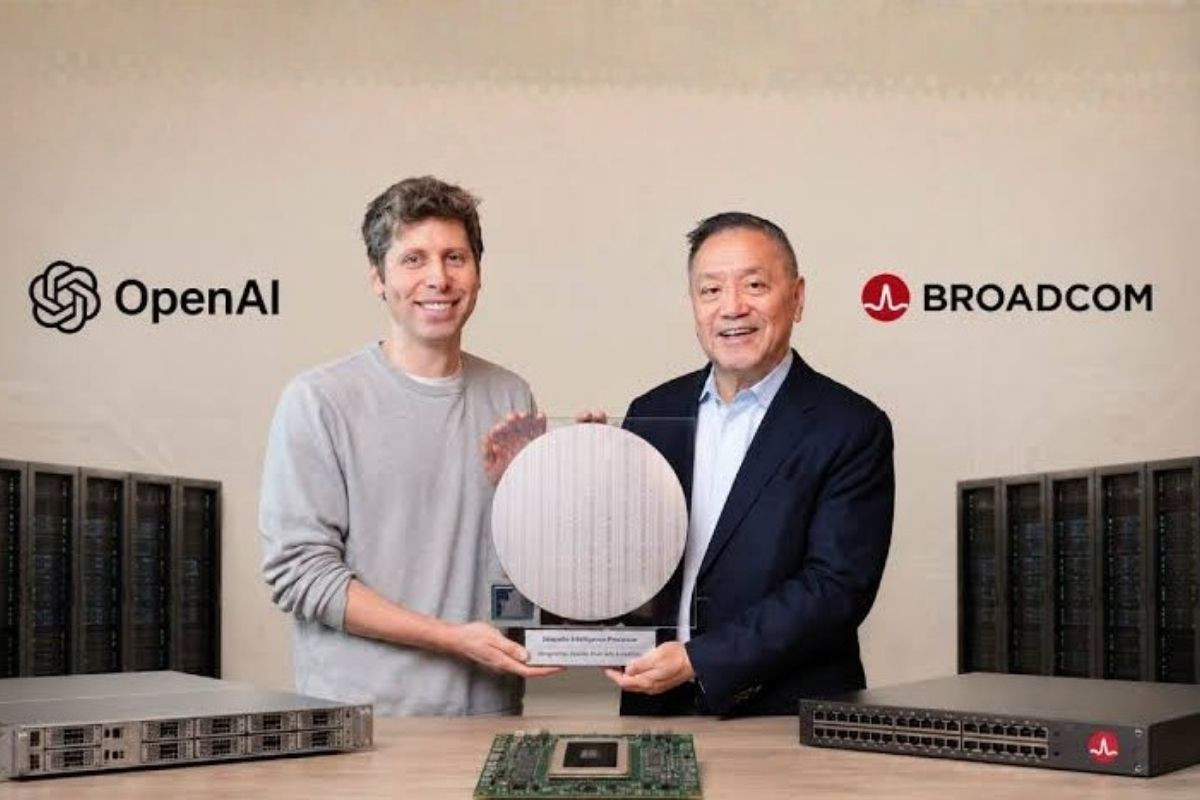
Broadcom is arranging more than $50 billion in private financing to fund OpenAI's custom AI chip program, according to a Wall Street Journal report on October 7, 2026 (UTC). Apollo Global Management and Blackstone are among the lenders in talks. If it closes, it would be the largest AI chip-financing package ever assembled — and the clearest signal yet that the compute industry is inventing new financial structures to keep up with frontier model demand.
The deal
The financing backs "Nexus," OpenAI's internal code name for a multi-generation custom silicon platform co-developed with Broadcom. The first chip, Jalapeño, was unveiled on June 24, 2026 (UTC) as OpenAI's first custom inference ASIC — built at TSMC 3nm and designed to cut inference costs roughly in half compared with current Nvidia GPUs. A second generation, code-named Serrano, is already in the roadmap.
OpenAI and Broadcom have committed to deploying 10 gigawatts of these accelerators between late 2026 and the end of 2029. The $50 billion+ package is intended to secure the manufacturing capacity and supply chain needed to hit that target. Broadcom aims to close the financing by the end of 2026, though the Journal cautions that talks are in early stages and the final size could shift.
The lenders aren't traditional bank syndicates. Apollo and Blackstone — two of the world's largest private credit firms — are leading the conversation. That matters: private credit has historically funded mid-market buyouts and real estate, not semiconductor capacity. The scale here is forcing a new asset class into existence.
Why it matters
This is not just another chip deal. It's a structural shift in how frontier AI gets built.
Three things stand out. First, the price tag. At $50 billion+, this package dwarfs the $42 billion Broadcom-Anthropic loan disclosed earlier in 2026 and would be the largest AI chip financing on record. Second, the customer. OpenAI is the most valuable private AI company in the world, and its decision to fund custom silicon through private credit rather than equity or bank debt tells you how hungry capital markets are for AI infrastructure exposure. Third, the Nvidia angle. Every gigawatt of Jalapeño that goes into OpenAI's data centers is a gigawatt that doesn't go to Nvidia. OpenAI has been explicit that inference — not training — is where its costs are exploding, and a purpose-built ASIC is the most direct way to attack that.
The financing model itself is the story. Private credit firms like Apollo and Blackstone are stepping into a space that banks used to own, because the amounts are too large and the collateral (chips with a single customer) is too specialized for traditional lenders. If this works, expect every major AI lab to copy the playbook — and expect private credit funds to become a permanent feature of the AI infrastructure stack.
The catch
A few things temper the enthusiasm. The talks are early. A $50 billion number in a WSJ story is not the same as a signed term sheet, and Broadcom has been here before — its Anthropic package took months to syndicate and the final terms were less favorable than initial discussions suggested.
Then there's concentration risk. These chips are designed for OpenAI's models and OpenAI's workloads. If OpenAI's revenue growth slows, or if a model architecture shift makes Jalapeño less efficient, the collateral behind this loan gets complicated fast. Private credit funds are pricing that risk, which means the interest rate on this package will be meaningful — potentially high enough to eat into the cost savings the chips are supposed to deliver.
And Nvidia isn't standing still. Blackwell and the next-generation Rubin platforms are improving inference performance on their own timeline. OpenAI's bet is that custom silicon can stay ahead of the general-purpose GPU curve on cost per token. That bet looked smart in June when Jalapeño launched. It will look smarter or less smart once Serrano ships and real workload numbers come in.
What to watch
- Closing timeline: Broadcom says it wants the deal done by end of 2026. If it slips into Q1 2027, that's a signal that lenders are pushing back on terms.
- Interest rate spread: The coupon on this financing will tell you how the market prices AI chip risk. Anything above 8% would be a yellow flag.
- Anthropic parallel: The Broadcom-Anthropic $42B package set the template. The OpenAI package tests whether the model scales to a second, even larger customer.
- Microsoft's role: Microsoft was reportedly lined up to buy ~40% of initial Jalapeño production for Azure. If that commitment grows or shrinks, it reshapes the demand picture behind the loan.
- Serrano timeline: The second-generation chip is where the real cost savings compound. A 2027 tape-out slip would pressure the entire financing thesis.
The Nexus program is OpenAI's most aggressive move yet to break Nvidia's grip on its cost structure. A $50 billion private credit package would make that move bankable — and would prove that AI infrastructure has become large enough to create its own financial plumbing.
No comments yet