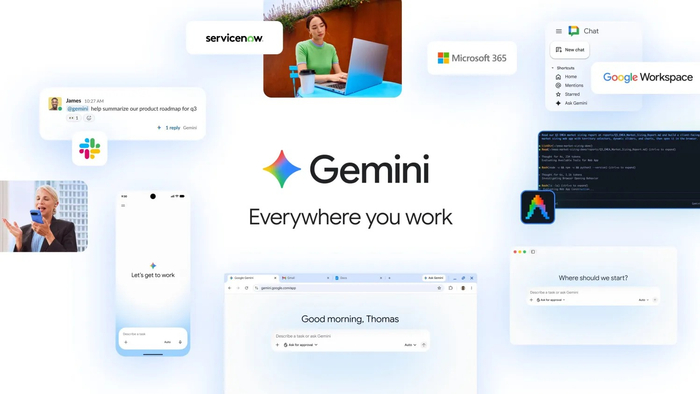
Google Cloud announced the Gemini agent at Gemini at Work 2026 on October 8, 2026 at 05:00 (UTC-7), positioning it as a "universal agent for work" that runs in the cloud, routes tasks across both Gemini and Claude models, and keeps working even when your laptop is closed. It's currently in private preview, with broader availability coming soon for Workspace Business and Enterprise customers.
What it actually does
The pitch is simple: give it objectives, not instructions. Tell Gemini you need a project update deck by Friday, and it figures out which documents to pull, which people to ping, and how to assemble the slides. Ask it to schedule a meeting with "the usual regional event leads," and it infers who those people are from your chat spaces and previous event threads, checks their calendars, and starts an email thread to coordinate — including external participants.
It operates in three modes:
| Mode | What it means | Example |
|---|---|---|
| Personal assistant | Works on your behalf | Drafting that slide deck your manager emailed about |
| Team member | Works for a group | Acting as project manager within a team |
| Role-based | Works for a specific function | Serving as an analyst in the finance department |
Source: Google Cloud announcement, October 8, 2026 (UTC-7).
Under the hood
The architecture is more interesting than the marketing. Three things stand out:
Multi-model routing. Gemini agent doesn't lock you into Google models. It "runs each job on the model that fits best," which today means both Gemini and Claude families, with support for other private and open models coming. This is a notable concession — Google is explicitly acknowledging that no single model wins every task, and that enterprise customers want choice.
Sub-agents for long-running work. The agent spawns sub-agents to handle multi-step tasks, coordinating parallel and sequential workflows that can run for hours or days. This isn't a chatbot that times out after a few minutes; it's designed for jobs that take a weekend.
Four-layer memory. Running in the cloud gives it a single set of memories across devices:
- Session memory — the current task, even if it runs for days
- Semantic memory — a structured knowledge base built from documents and conversations
- Procedural memory — how jobs get done, including skills it writes for itself
- Episodic memory — everything it has done before
That last one is the sleeper feature. An agent that remembers how it solved a similar problem last quarter is fundamentally different from one that starts fresh every session.
Why it matters
This is Google's answer to OpenAI's Dot (announced September 29, 2026 at DevDay) and Anthropic's managed agents, but with a critical difference: it's built for the enterprise from day one. Dot is a consumer product with a cloud computer. Gemini agent is a Workspace-native tool with IAM permissions, audit logs, and cost controls baked in. That matters because the enterprise agent market is where the real revenue is — and where Google already has distribution through Workspace and Cloud.
The multi-model routing is the strategic tell. Google is positioning Gemini agent as a neutral orchestration layer, not just a wrapper around its own models. If enterprises buy into this vision, Google becomes the switchboard for AI work regardless of which model wins a given benchmark. That's a much more defensible position than trying to beat OpenAI and Anthropic on raw model performance alone.
The four-layer memory system also signals where the competition is heading. The next phase of agent wars won't be about who has the smartest model — it'll be about who has the best memory of how your organization actually works. Google's advantage here is obvious: it already has your emails, documents, calendars, and chats.
The catch
Private preview means most people can't use this yet. Google hasn't announced pricing, and "broad availability soon" is vague. The enterprise governance features are promising but unproven at scale — an agent with procedural memory that writes its own skills is also an agent that can develop bad habits and propagate them across an organization.
The Claude integration is also worth watching skeptically. Google routing tasks to Anthropic's models is either genuine openness or a way to claim model neutrality while defaulting to Gemini in practice. We won't know until independent users test whether Claude actually gets called for the tasks it's best at.
And there's the elephant in the room: OpenAI already shipped Dot, and Microsoft is baking Copilot agents into every enterprise product it sells. Google is late to the general-purpose agent party, even if its enterprise integration is deeper.
What to watch
- Pricing announcement: Google hasn't said what this costs. If it's bundled into existing Workspace Enterprise plans, that's a distribution juggernaut. If it's a pricey add-on, adoption will be slower.
- Claude routing in practice: Independent tests will reveal whether Gemini agent actually uses Claude for coding and complex reasoning, or whether it's marketing.
- Memory controls: Enterprises will demand granular control over what the agent remembers and for how long. Google's IAM integration will be tested here.
- Dot vs. Gemini agent comparison: Expect side-by-side tests by enterprise buyers within weeks of broad availability.
- Open model support: When Google adds Llama, Mistral, or DeepSeek models to the routing, that's when it becomes a true neutral platform.
The agent wars just got a third major contender with deeper enterprise roots than either of its rivals. Whether that's enough to overcome OpenAI's first-mover advantage and Microsoft's distribution is the question that will define enterprise AI in 2027.
No comments yet