A federal judge in San Jose signaled on October 14, 2026 (UTC-7) that he is "highly likely" to grant Apple a preliminary injunction barring OpenAI from using trade secrets the iPhone maker claims were stolen — a ruling that could derail OpenAI's ambitions to build its first consumer hardware device. The same day, OpenAI fired back with its own explosive allegation: a former employee who returned to Apple took more than a hundred confidential files, including detailed images of an unreleased OpenAI product, and presented them to Apple's senior leadership.
What began in July as a lawsuit over two former Apple engineers has escalated into the most consequential legal battle in AI hardware, with both giants now accusing each other of the same crime.
How we got here
Apple filed suit on July 10, 2026 (UTC-7) in the Northern District of California, naming OpenAI, its hardware subsidiary io Products, and two ex-employees: Chang Liu, a senior electrical engineer, and Tang Yew Tan, a former vice president of product design who oversaw iPhone, AirPods, and Apple Watch development.
The core allegation against Liu is unusually specific. Apple claims Liu kept his company-issued MacBook after resigning and exploited an authentication flaw in Apple's internal systems to access confidential files on at least five occasions between February and April 2026 — after he had already started working at OpenAI. The downloaded material, Apple says, spans thousands of pages covering custom display power management, hardware architecture, and manufacturing data.
Apple also accuses OpenAI of running a systematic campaign to hire its engineers and coach them on circumventing internal security controls. io Products, the hardware joint venture co-founded by Tan alongside former Apple chief design officer Jony Ive and his successor Evans Hankey, sits at the center of that effort.
OpenAI has called the lawsuit "careless, aggressive and oddly personal," insisting it does not "have, nor want, any of their trade secrets."
The October 14 hearing: two bombshells
At a hearing on October 14, 2026 at approximately 10:00 (UTC-7) in San Jose, Judge Edward J. Davila told the courtroom he is "highly likely" to grant Apple's motion for a preliminary injunction. Such an order would force OpenAI to immediately cease using any of Apple's allegedly stolen confidential information and halt further efforts to acquire it while the case proceeds.
Bloomberg reported that an injunction would "mark a potential setback" for OpenAI's hardware development. The company's first consumer device — a screenless, hockey-puck-sized smart speaker with moving parts and a $300–$400 price tag, according to Bloomberg — has already been delayed to early 2027 by a separate trademark dispute.
Hours earlier, in a court filing, OpenAI turned the tables. The company alleged that an unnamed employee who joined OpenAI from Apple and then returned to Apple after six months sent "over a hundred highly confidential files" to personal accounts, including manufacturing data and detailed images of at least one unreleased OpenAI product. That person, OpenAI claims, "made a presentation" on OpenAI product plans to Apple's senior leadership "months ago."
"OpenAI is very concerned that its trade secret and confidential information is now circulating inside Apple, where Apple engineers can shape Apple's upcoming products based on OpenAI's confidential and innovative work," the filing reads.
Apple told Reuters it has found no evidence to support OpenAI's claims and maintains policies preventing new hires from using previous employers' confidential information.
The discovery ruling that set the stage
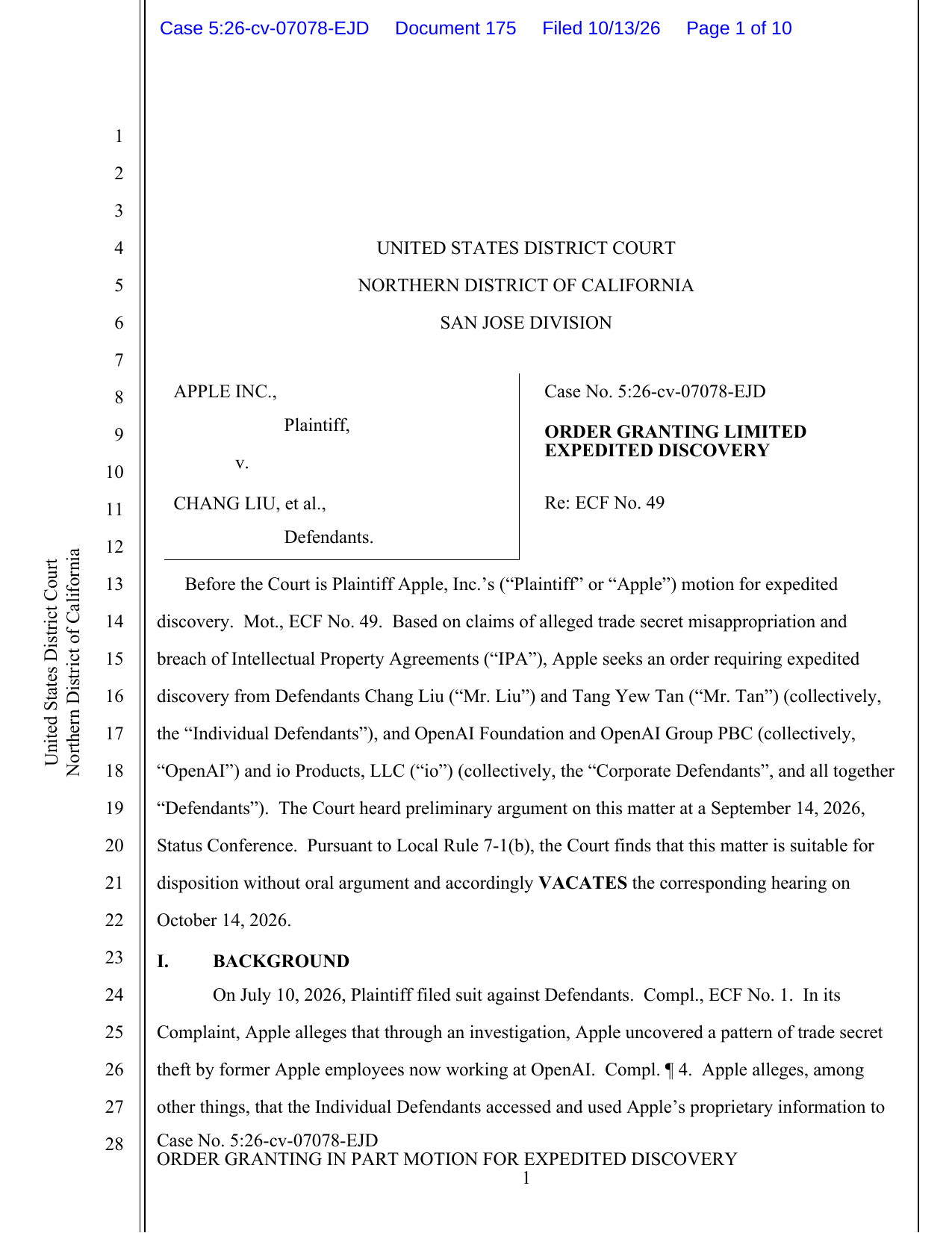
On October 13, 2026 (UTC-7), Judge Davila partially granted Apple's request for expedited discovery. OpenAI has up to two weeks to hand over forensic evidence and materials used when interviewing former Apple employees. Liu, Tan, and Alyssa Peng — Liu's former Apple colleague — will be deposed.
The court also granted Apple's request to depose OpenAI under Rule 30(b)(6) on at least one topic, specifically targeting the company's hiring practices and what it knew about the alleged theft.
Why this matters
This is not a routine employment dispute. It is a fight over who gets to define the next decade of consumer AI hardware, and the legal mechanism Apple chose — the federal Defend Trade Secrets Act of 2016 — gives it teeth that ordinary breach-of-contract claims lack.
The most immediate question is whether a preliminary injunction forces OpenAI to quarantine or rebuild parts of its hardware program. Trade secret injunctions often require defendants to show they have "clean roomed" affected teams — segregating employees who had access to stolen information and re-deriving work independently. For a hardware team staffed heavily by Apple alumni, that is not a trivial exercise. It could mean months of delay and millions in re-engineering costs at a moment when OpenAI is trying to ship its first physical product.
The OpenAI counterclaim adds a layer of mutual assured destruction. If both companies are found to have each other's confidential product plans, the case becomes less about who stole what and more about whether either side can prove measurable harm. That dynamic historically pushes parties toward settlement — think Waymo v. Uber in 2017, which ended with Uber paying $245 million in equity and agreeing to a forensic audit. A similar resolution here would likely involve cross-licensing, mutual clean-room certifications, and a hefty transfer of value from whichever side the evidence favors.
There is also a competitive subtext that goes beyond the courtroom. Apple shifted its Siri strategy to Google Gemini in 2026, ending its partnership with OpenAI. OpenAI responded by moving into hardware — Apple's home turf. The lawsuit is the legal expression of a relationship that curdled from alliance to rivalry in under two years. If OpenAI's device reaches consumers in 2027, it will compete not just with HomePod but with Apple's entire vision of ambient AI. A favorable ruling for Apple could slow that challenge enough to matter.
The numbers behind the stakes are worth sitting with. OpenAI's hardware effort is backed by a joint venture with Jony Ive's design studio and has drawn talent from the upper echelons of Apple's product organization. Tang Tan alone led design for products generating tens of billions in annual revenue. Losing access to the institutional knowledge he and his team brought — or having that knowledge tainted by an injunction — would force OpenAI to rebuild expertise it spent a year acquiring.
What to watch next
Three signposts will determine whether this becomes a settlement or a years-long war:
-
The written injunction order. Judge Davila's "highly likely" comment from the bench is not a final ruling. When he issues the written order — expected within days — the scope of the prohibited conduct and any clean-room requirements will define how much of OpenAI's hardware program is affected.
-
The depositions. Chang Liu's testimony, in particular, will either corroborate Apple's narrative of deliberate exfiltration or expose gaps in the authentication-flaw claim. Liu's messages to Alyssa Peng — including one in which he reportedly wrote "LOL, I found I can access the network storage, so funny" — are already in the court record.
-
OpenAI's counterclaim. If OpenAI follows through and files formal counterclaims against Apple over the returned employee, the case transforms into a bilateral trade secrets war. Settlement pressure rises sharply in that scenario.
The hardware OpenAI has been building — a screenless speaker with personality, priced to compete with HomePod — was supposed to be the company's answer to Apple's ecosystem lock-in. Whether it ever ships on schedule may now depend on a judge in San Jose.
No comments yet