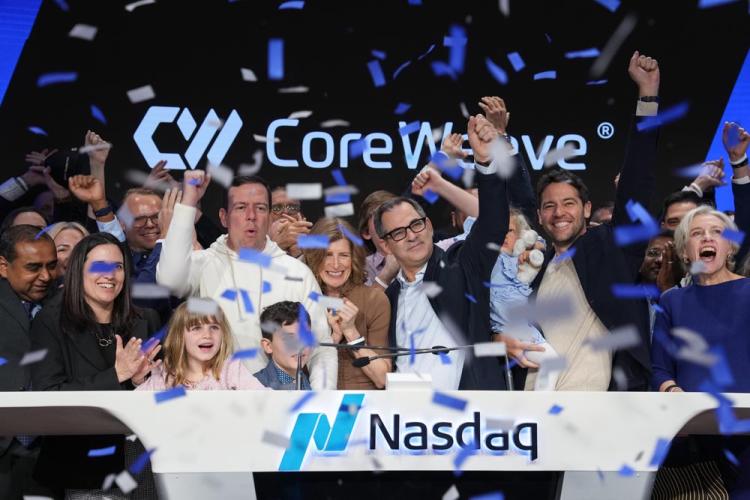
CoreWeave's founders cashed out $3.3B before the crash
The confetti had barely settled at CoreWeave's NASDAQ opening bell in March 2025 before the three founders started selling. And they haven't stopped.
Bloomberg reported on October 15, 2026 (UTC-4) that Michael Intrator, Brian Venturo, and Brannin McBee — the trio who built CoreWeave from a Ethereum mining operation into the most valuable AI cloud company on earth — have collectively sold $3.3 billion worth of stock since the company went public. Nearly $2.4 billion of that was sold in 2026 alone, the same year CoreWeave's credit default swaps blew past 1,194 basis points and its bonds started trading at yields above 15%.
The timing is the story.
Who sold what
| Founder | Total sold since IPO | Sold in 2026 | % of IPO stake sold |
|---|---|---|---|
| Michael Intrator (CEO) | ~$1.0B+ | $907M | 16.5% |
| Brian Venturo | $1.2B+ | $734M in Q2 alone | 35%+ |
| Brannin McBee | $1.06B | $577M | 40.4% |
| Combined | $3.3B | $2.4B | — |
Source: Bloomberg, October 15, 2026 (UTC-4), based on SEC filings and insider trading records
Intrator made the top five list of insider sellers at U.S. public companies for two consecutive quarters. Venturo was the second-largest insider seller in America during Q2 2026. McBee has converted roughly 40% of his personal net worth into cash and cash equivalents, according to Bloomberg's Billionaires Index. Before the IPO, in 2023 and 2024, the same trio pulled out another $488 million through tender offers.
CoreWeave's spokesperson pushed back in an email statement: the founders still hold about 20% of the company, remain among its six largest shareholders, and the sales were "routine portfolio diversification" that was "pre-arranged and fully disclosed."
That's all true. It also doesn't change what the market sees.
Why insiders selling matters here
Founders sell stock all the time. When a company's stock has risen 359% in three months, as CoreWeave's did after its IPO, taking some money off the table is rational. The problem is what happened next — and what the founders knew while they were selling.
CoreWeave's five-year CDS spread hit 1,194.5 basis points on October 14, 2026 (UTC-4), implying a greater than 60% probability of default within five years. Its 2031 bonds trade below 80 cents on the dollar. The company carries roughly $50 billion in total debt against $679 million in quarterly operating cash flow. Visible Alpha consensus forecasts $71 billion in cumulative negative free cash flow from 2026 through 2028. D.A. Davidson analyst Gil Luria calls it an "AI subprime asset."
The founders sold $2.4 billion in 2026 while these numbers were developing. They know the maturity schedule of the debt. They know which customer contracts expire when. They know the depreciation curve of the GPUs backing those loans. They know whether the $104 billion backlog is real, contracted, and non-cancelable — or whether it contains the kind of flexible terms that let Microsoft or OpenAI walk away if prices fall.
That doesn't make the sales illegal. Insider selling plans (10b5-1) are designed to allow exactly this. But it does mean the people with the best information about CoreWeave's true financial health chose to convert their equity into cash at a pace that placed them among the most aggressive insider sellers in corporate America.
The $15 billion they didn't save
For all the selling, the crash still cost them. From the June 2025 peak, CoreWeave shares have fallen more than 60%. The three founders' remaining holdings have lost approximately $15 billion in paper value. Intrator's net worth peaked at $11.8 billion, according to Bloomberg.
That number cuts both ways. Bulls say: if they knew the company was doomed, they would have sold everything. Bears say: they sold enough to guarantee generational wealth regardless of outcome, while public shareholders and bondholders are left holding the risk.
The spokesperson's "routine diversification" framing is harder to sustain when one founder has 40% of his wealth in cash and the company's bonds are pricing in a majority chance of default. Diversification doesn't typically require being the second-largest insider seller in the entire country in a single quarter.
What to watch
Three things will determine whether this is a footnote or the beginning of a reckoning:
-
SEC scrutiny. Aggressive insider selling ahead of a credit crisis often draws regulatory attention, especially when 10b5-1 plans were modified or adopted close to material non-public information. Watch for any SEC inquiry into the timing of plan adoptions and modifications.
-
Q3 earnings. CoreWeave reports Q3 results in the coming weeks. If revenue misses, if the backlog shrinks, or if customer concentration increases beyond the current Microsoft/OpenAI/Meta reliance, the bond market will move faster than the stock. The founders' sales will look very different if Q3 shows deceleration.
-
Nvidia's next move. Jensen Huang said on October 15, 2026 (UTC+2) in Stockholm that CoreWeave doesn't need a Nvidia backstop. Nvidia already owns ~10% and has agreed to buy $6.3 billion of unsold capacity through 2032. If Nvidia converts that implicit support into an equity injection or a debt guarantee, the founders' decision to sell at these levels will look like a misjudgment. If Nvidia stays on the sidelines, it will look like foresight.
The CoreWeave story was always about leverage — financial leverage, operational leverage, and the leverage of being Nvidia's favorite child. The founders just reminded everyone that there's a fourth kind: the leverage of knowing when to walk away.
They took $3.3 billion off the table. The question is whether the rest of the market gets the same exit.
No comments yet