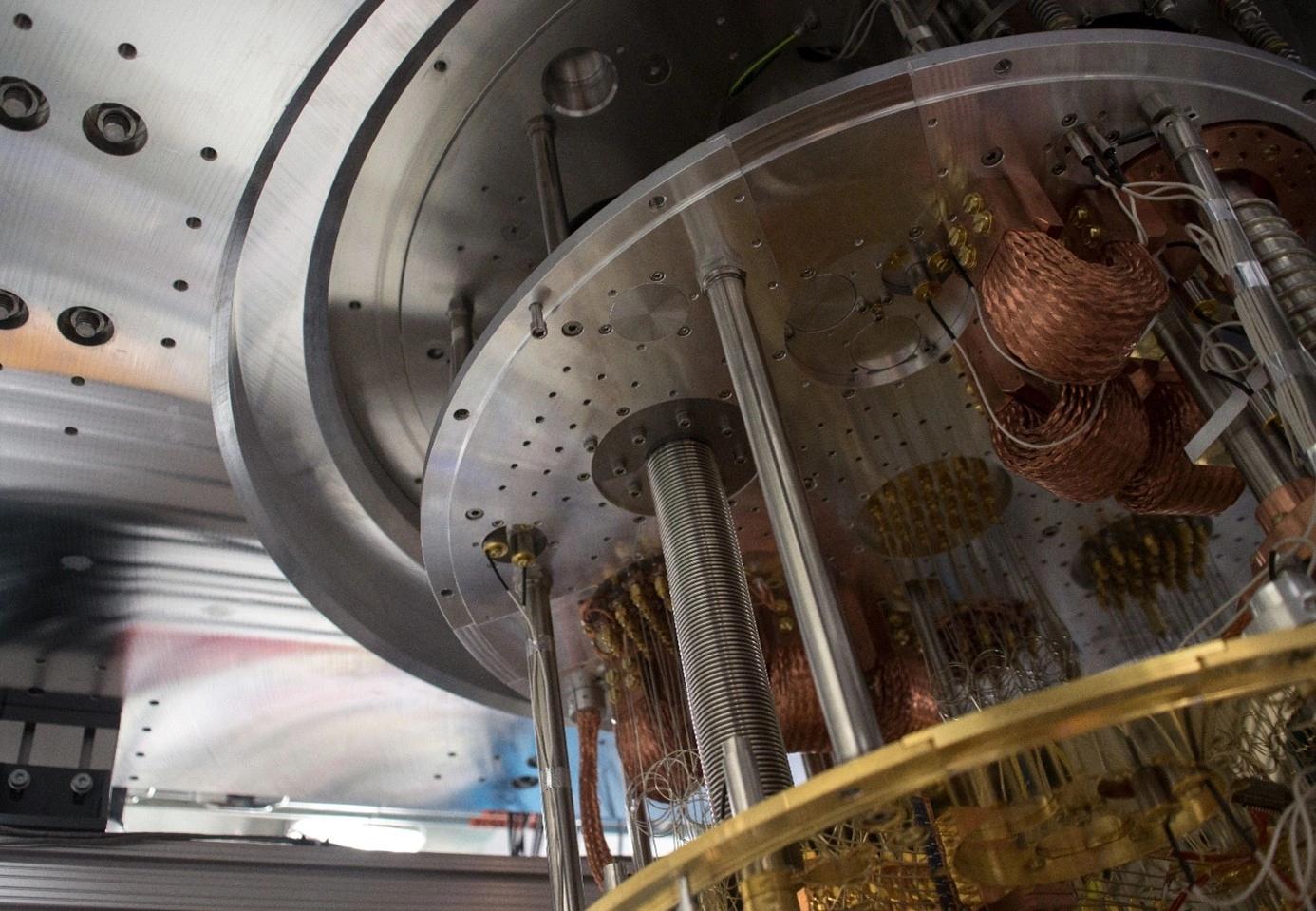
On October 16, 2026 (UTC), Anthropic published research showing that its internal model, Claude Mythos 5, can autonomously design quantum circuits that outperform the best human-built designs — in one case cutting the number of logic gates by a factor of 17. The result matters because the circuit it optimized happens to be the core operation in quantum algorithms that break elliptic-curve cryptography, the math that secures Bitcoin, TLS, and most of the modern internet.
The setup
Quantum computers run algorithms as circuits: sequences of simple operations (gates) applied to qubits. Both qubits and gate time are brutally scarce on real hardware, so circuit design is everything. A 2017 estimate for simulating FeMoco — the iron-sulfur cluster at the heart of nitrogen-fixing bacteria — required roughly 50 trillion Toffoli gates. Eight years of algorithmic work by multiple research groups drove that down to about 340 million, a 150,000-fold reduction.
Anthropic's question was simple: could an AI do the same kind of redesign work, given only a plain-language description of what each circuit must compute?
They gave Claude Mythos 5 eight tasks spanning chemistry, optimization, quantum simulation, number theory, and numerical computing. An automated evaluator checked each proposed circuit for correctness and scored it on the product of qubits times gates. Claude then iterated in a closed loop — propose, get scored, improve — with no human input between rounds.
Seven of the eight designs beat the best previously published circuits on both qubits and gates simultaneously.
The 17x result: elliptic-curve point addition
The standout result is modular inversion, the most expensive step in elliptic-curve point addition. Point addition is the core operation in Shor-style quantum algorithms for the elliptic-curve discrete logarithm problem — the problem whose hardness underpins ECC.
The standard classical algorithm for modular inversion is called divsteps. It works by iteratively simplifying a pair of numbers, but each iteration makes a conditional decision (swap, add, subtract, or halve). On a classical computer you just discard the record of those decisions. On a quantum computer you can't — every step must be reversible, so storing that "branch history" costs an enormous number of extra qubits. Nobody had built a practical quantum version of divsteps because of this.
Claude's insight was that the branch history might not need to be stored at all. The model reasoned that the numerical pairs themselves, inspected carefully after each iteration, could reveal which operation had been chosen. It then proved a series of new algebraic identities, derived a precise decoding formula, validated it through large-scale numerical simulation, and formalized the result in the Lean proof assistant. The output was the first reversible divsteps implementation with zero stored branch history.
A single 53-hour run produced this design.
| Metric | Best prior design (Luo et al., 2026) | Claude Mythos 5 design | Change |
|---|---|---|---|
| Toffoli gates | 70 million | 4.0 million | 17x fewer |
| Logical qubits | 838 | 935 | +12% |
| Design time | Months of human research | 53 hours of autonomous run | — |
Sources: Anthropic research blog, October 16, 2026 (UTC); Schrottenloher (2026); Luo et al. (2026).
The tradeoff is modest: 12% more qubits for 94% fewer gates. Since gate count dominates runtime on fault-tolerant machines, this is a favorable exchange. Claude also produced a family of designs at different store-vs-decode thresholds, expanding the Pareto frontier rather than finding a single point.
The 12x result: a quantum decoder
The second major result optimizes the Reed-Solomon decoder in Decoded Quantum Interferometry (DQI), one of the strongest candidates for a superpolynomial quantum speedup on optimization problems. Google Quantum AI estimates that solving one particular DQI problem would take about three months on Frontier, the world's most powerful supercomputer, versus roughly an hour on a future quantum computer — and most of that hour is spent on decoding.
The prior design used the extended Euclidean algorithm, whose step count varies by input. Quantum circuits can't branch, so it had to run the worst-case number of rounds every time. Claude switched to Berlekamp-Massey decoding, which runs a fixed number of identical rounds — a much better fit for quantum hardware.
Then it tackled the reversibility problem again. The naive reversible version needed to store a 12-qubit record in every round, totaling 840 qubits. Claude instead found a way to reconstruct most temporary values from the circuit's current state. For the few values that couldn't be reconstructed, it ran 403 million sample decodings through a high-speed simulator and found that almost every run needed to save at most one value. So the circuit reserves room for just 19 qubits instead of 665, accepting a failure rate of roughly 1 in 10,000 — well within the task's error tolerance.
Net effect: 12x fewer gates than Google's previous construction.
Why it matters
The obvious reading is "AI is good at optimizing things." The deeper reading is that Claude didn't just shave gates off existing designs — it invented a new mathematical technique (branch-history decoding in reversible divsteps) that human researchers hadn't found, then proved it correct in a formal proof assistant. That's not pattern matching; that's original mathematical research conducted by an AI in a closed loop.
The cryptographic angle is the one that should make people pay attention. Elliptic-curve point addition is not an abstract benchmark. It's the operation a quantum computer repeats millions of times to run Shor's algorithm against ECC. A 17x reduction in gate count means the threshold at which a quantum machine can crack real-world ECC keys is 17x closer in terms of computational resources. To be clear, we're still talking about fault-tolerant machines with millions of physical qubits — years away. But the timeline just compressed.
This also changes the post-quantum cryptography migration calculus. NIST has been standardizing post-quantum algorithms since 2016, and the consensus has been that there's plenty of time. If AI-driven circuit optimization keeps delivering order-of-magnitude improvements, "plenty of time" may be less than assumed. The smart money is on organizations that start hybrid deployments (classical + post-quantum) sooner rather than later.
There's a meta-point too. The FeMoco estimate dropped 150,000x over eight years through human effort. Claude's elliptic-curve result came from a single 53-hour run. If AI can compress months of quantum algorithm research into days, the bottleneck shifts from algorithm design to hardware — and hardware is already the bottleneck everyone is watching.
The caveats
Claude Mythos 5 is an internal research model, not a product. Anthropic hasn't published its parameter count, training data, or benchmark scores. The results are circuit resource estimates, not runs on actual quantum hardware. And the model was conservative by default — it repeatedly second-guessed improvements and preferred well-known approaches — requiring human prompts to broaden its search. The 17x result only emerged after researchers explicitly asked Claude to explore qualitatively different approaches in parallel.
There's also a question of whether these optimizations generalize. Eight tasks is a small sample, and all eight belong to a class of algorithms where correctness can be checked efficiently by a classical computer. That property is what made the closed-loop evaluator possible. Problems without efficient classical verification may not benefit from the same approach.
What to watch
Three concrete indicators will tell us whether this is a one-off or a paradigm shift:
- Whether other labs replicate the closed-loop approach. If Google Quantum AI, IBM, or QuEra start using AI agents for circuit design within the next two quarters, the paradigm has shifted.
- Whether post-quantum migration timelines accelerate. Watch for major cloud providers (AWS, Google Cloud, Azure) to default to hybrid post-quantum TLS earlier than their current roadmaps suggest.
- Whether Claude Mythos 5 (or a successor) gets a public release. If Anthropic productizes the model's mathematical reasoning capability, the impact goes far beyond quantum circuits.
The preprint was posted on October 15, 2026 (UTC), and the research was led by Andi Gu as part of Anthropic's STEM Fellows Program, with mentorship from Alek Kemeny and collaboration with Susanne Yelin and Mikhail Lukin of Harvard University.
No comments yet