On September 8, 2026 at approximately 14:00 (UTC), OpenAI dropped something that made mathematicians around the world stop scrolling. An internal AI system — running a model more capable than GPT-6 Astra, which hasn't been released publicly — produced a proof that the Navier–Stokes equations can develop a singularity in finite time. That's one of the seven Millennium Prize Problems, each carrying a $1 million award from the Clay Mathematics Institute. If it holds up, it's only the second one ever solved.
The problem that resisted 90 years
The Navier–Stokes equations describe how fluids move — water, air, blood, everything. They were written down in the 19th century by Claude-Louis Navier and George Gabriel Stokes, and they're the foundation of aircraft design, weather forecasting, and fluid simulation.
The tricky part isn't writing the equations down. It's proving that their solutions always behave. Specifically: if you start with a perfectly smooth fluid and apply a smooth force, does the velocity stay smooth forever? Or can it blow up — reach infinite speed — in finite time?
Jean Leray proved in 1934 that solutions exist in a generalized sense, but whether they remain smooth stayed open. The Clay Institute listed it as a Millennium Prize Problem in 2000. Since then, only the Poincaré Conjecture (solved by Grigori Perelman in 2003) has been crossed off the list.
What OpenAI's agents found
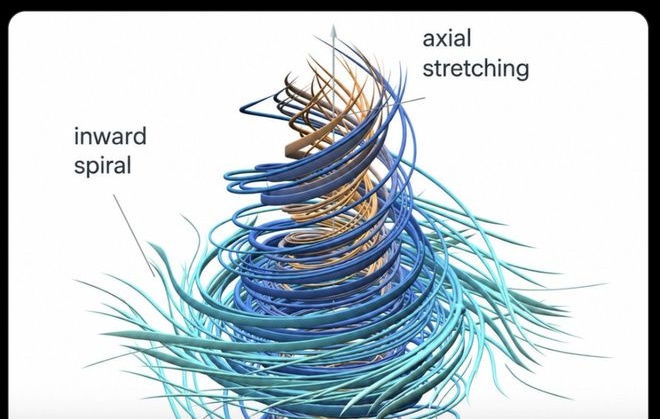
The proof constructs a vortex — a spinning swirl of fluid that spirals inward and stretches axially. Its center shrinks and speeds up in a way that keeps total energy finite, while the velocity grows without bound. The key technical achievement is that the blow-up arises from the fluid's own motion, not from an imposed infinite force. Acceleration, pressure gradients, momentum transfer, and viscosity all grow large yet cancel precisely.
OpenAI's system established versions C and D of the official problem formulation, which means it disproved smoothness — the answer to the prize question is that solutions can break down.
How 10,000 agents solved it in 88 hours
The numbers behind this are almost as striking as the result itself:
| Metric | Value |
|---|---|
| Model used | Internal next-gen model, "significantly more capable" than GPT-6 Astra |
| Concurrent agents | ~10,000 |
| Time to find proof | ~88 hours (Sept 1–5, 2026) |
| Lean formalization | 17 hours, done by GPT-6 Astra |
| Paper length | 165 pages |
| Messages sent (all problems) | 4.9 million |
| Output tokens (all problems) | ~300 billion |
| Navier–Stokes messages | 2.7 million |
| Navier–Stokes tokens | ~130 billion |
The agents had access to a cached internet and could run code. They were subdivided into groups that communicated internally. As a warm-up, nearly 100 agents spent ~50 hours resolving the regularity problem for the Euler equations (the zero-viscosity limit of Navier–Stokes) in the unforced case — a result that surprised OpenAI's own researchers. The team then shifted agents to Navier–Stokes, prompted them with the Euler result, and used Codex to consolidate insights across groups.
OpenAI says it does not intend to claim the $1 million Millennium Prize.
The controversy
The announcement came 12 hours after Tristan Buckmaster (NYU) and Levent Alpöge (Anthropic) published their own results on closely related problems — finite-time blowup for incompressible porous media, Boussinesq, and 3D incompressible Euler with forcing. They had used Claude and Codex in nearly a year of personal collaboration, with a breakthrough on August 15, 2026 (UTC) and Lean verification on August 22, 2026 (UTC).
OpenAI says it launched its effort on September 1, 2026 (UTC) after hearing rumors that two Millennium Prize problems had been resolved. After completing its proof on September 6, 2026 (UTC), the company reached out to Buckmaster and Alpöge proposing a joint release, at which point it learned they had solved the forced Euler problem — not Navier–Stokes itself.
Buckmaster, in a public statement, described emails and calls with OpenAI and declined two proposals from the company. He emphasized he is making no accusation against anyone. OpenAI says its researchers and agents did not see the pair's work before it was public, though it cannot rule out that de-identified data from their product usage helped improve models.
The underlying mathematical strategy traces back to Diego Córdoba (ICMAT Madrid) and Luis Martínez-Zoroa (CUNEF), who pioneered analytic techniques that don't rely on computers. Charles Fefferman of Princeton, who wrote the Clay Institute's official problem description, called the result thrilling and said the heroes are Córdoba and Martínez-Zoroa.
What this means
A formally verified proof in Lean gives mathematicians strong confidence that the argument is correct, though the Clay Institute still lists the problem as unsolved and the broader community is reviewing the 165-page paper.
Practically, singularities in an idealized continuum model don't change how engineers design airplanes — real fluids are made of molecules, not infinitely divisible stuff. But conceptually, it's a landmark: the most important mathematical proof yet produced by an AI system, found by a swarm of 10,000 agents in less than four days, using a model the public can't even access yet.
If the internal model is this far ahead of GPT-6 Astra at mathematics, the question isn't whether AI will reshape mathematical research. It's how fast.
Sources: OpenAI official announcement (openai.com/research), Quanta Magazine, Unite.AI, RuntimeWire, Buckmaster/Alpöge public statement.
No comments yet