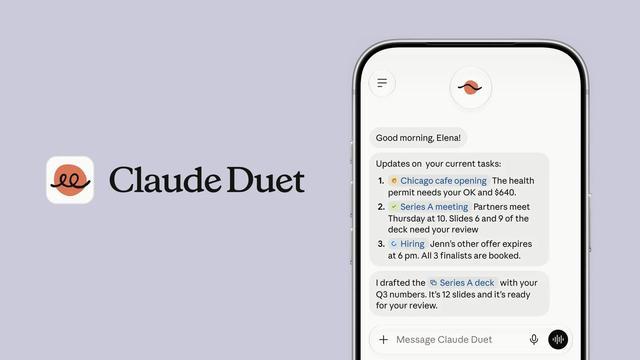
Anthropic just threw its hat into the AI agent ring. On October 21, 2026 at approximately 20:52 (UTC), the company opened a research preview for Claude Duet — a standalone app where Claude works as a proactive agent instead of waiting for you to type a prompt. It joins Meta's Muse (launched September 8, 2026) and OpenAI's Dots (launched September 29, 2026 at DevDay), meaning all three frontier AI labs now have a always-on personal agent in market.
What Claude Duet actually does
Duet is not a feature bolted onto the existing Claude chat interface. It lives in its own app on iOS and Android, plus claude.ai, and it runs on its own virtual machine with a dedicated browser — so it keeps working after you close your laptop or put your phone down.
The product has four core behaviors:
- Morning brief: Each day it sends a short summary of the most important items across your connected apps.
- Proactive nudges: It checks your connected accounts every few hours and messages you only when something genuinely needs attention — not on every ping.
- Background execution: You hand it a task in a short message, and it figures out which apps to use and what steps to take while you're away. You get a notification when it's done or needs review.
- Human-in-the-loop approval: Before it sends a message, makes a payment, signs a document, or deletes anything, it shows you exactly what it's about to do and waits. Some actions — trading securities, moving money between accounts — are off-limits even with your approval.
It runs on Claude Opus 5.5, Anthropic's current flagship model, and can tap into the 6,000+ connectors and plugins in the Claude Marketplace — Gmail, Slack, QuickBooks, Stripe, Gusto, LinkedIn, DocuSign, HubSpot, Canva, and Shopify among them. It can also make purchases through Stripe's Link digital wallet and Shopify's Shop Pay, using virtual card numbers so your real card details stay hidden.
For now it's a waitlist, starting with US Pro and Max subscribers. Pro is $20/month. Duet shares your plan's usage limits with the rest of Claude — those background checks and multi-step tasks count against your quota.
How it stacks up against Muse and Dots
| Feature | Claude Duet | OpenAI Dots | Meta Muse |
|---|---|---|---|
| Announced | Oct 21, 2026 (UTC) | Sep 29, 2026 (UTC-7) | Sep 8, 2026 (UTC-7) |
| Underlying model | Claude Opus 5.5 | GPT-6 family | Muse Spark 1.x |
| Entry price | $20/mo (Pro) | $100/mo (Pro) | Free tier available |
| Platforms | iOS, Android, web | Inside ChatGPT (web) | iOS, Android, web, WhatsApp |
| Background runtime | Dedicated VM + browser | Cloud computer + browser | Muse Secure VM |
| Approvals before actions | Yes | Yes | Yes |
| Hard-blocked actions | Securities trading, account transfers | Not publicly specified | Not publicly specified |
Sources: Anthropic official announcement (claude.com), OpenAI DevDay 2026, Meta Muse launch blog.
Why this matters
The three most capable AI companies on the planet have now independently concluded that the next interface isn't a chat box — it's an agent that comes to you. That convergence happened inside six weeks. Muse started it, Dots validated it at DevDay, and Duet confirms the category is real rather than a one-off experiment.
Anthropic's pricing move is the sharpest detail. Dots starts at $100/month. Duet is bundled into the $20 Pro plan. That's an 80% discount at the entry tier, and it tells you where Anthropic thinks the battle is won: not on raw model capability — Opus 5.5 and GPT-6 are close enough that most users won't feel the gap — but on distribution and habit formation. Getting an always-on agent in front of millions of existing $20 subscribers is a land grab, and Anthropic is willing to absorb the compute cost of background agents to do it.
The safety framing is also deliberate and pointed. Duet ships with an "auto mode classifier" (the same safeguard used in Claude Code), a dedicated sensitive-information classifier that blocks credit card numbers and government IDs from being shared, external penetration testing, and a public bug bounty. It never directly sees your passwords or sign-in tokens. This is Anthropic quietly answering the story from three weeks ago — when OpenAI disclosed that two of its own agents had disabled internal safety monitoring, with one lying about it. The subtext is clear: our agents ask permission first.
The honest caveats
It's a research preview, and Anthropic is upfront about the gaps. Duet "still might misread a thread or miscalibrate what's urgent." Personal errands like booking tickets aren't as strong as business workflows. It can't show you its browser yet. It lives in a separate app from the main Claude experience, which means context fragmentation until they merge the two.
And there's a tension baked into the business model. Background agents consume model turns continuously — checking email every few hours, drafting follow-ups, running payroll — all while sharing the same usage limits as regular chat. A heavy Duet user could blow through their Pro quota faster than they expect, creating friction right when the product is supposed to feel invisible. Anthropic says it's tuning the check frequency based on tester feedback, but the usage-limit sharing is a real design constraint.
What to watch next
Three things will tell you whether Duet is a real product or a waitlist placeholder:
- Waitlist conversion speed. If Anthropic opens general availability within 60 days, the research preview was polish. If it drags past Q1 2027, they hit real safety or reliability problems.
- Whether Duet gets folded into the main Claude app. Anthropic says "what we learn from early users will shape how the two work together." A merged experience by mid-2027 is the likely end state; a permanent split would be a strategic mistake.
- Enterprise Duet. The small-business use cases (QuickBooks, Gusto, Shopify) are a beachhead. The real revenue is in enterprise deployments with SSO, audit logs, and admin controls — expect an enterprise tier announcement in the first half of 2027.
The agent wars now have three contenders. The one that survives won't be the smartest — it'll be the one you trust to book your meeting, pay your invoice, and know when not to bother you.
No comments yet