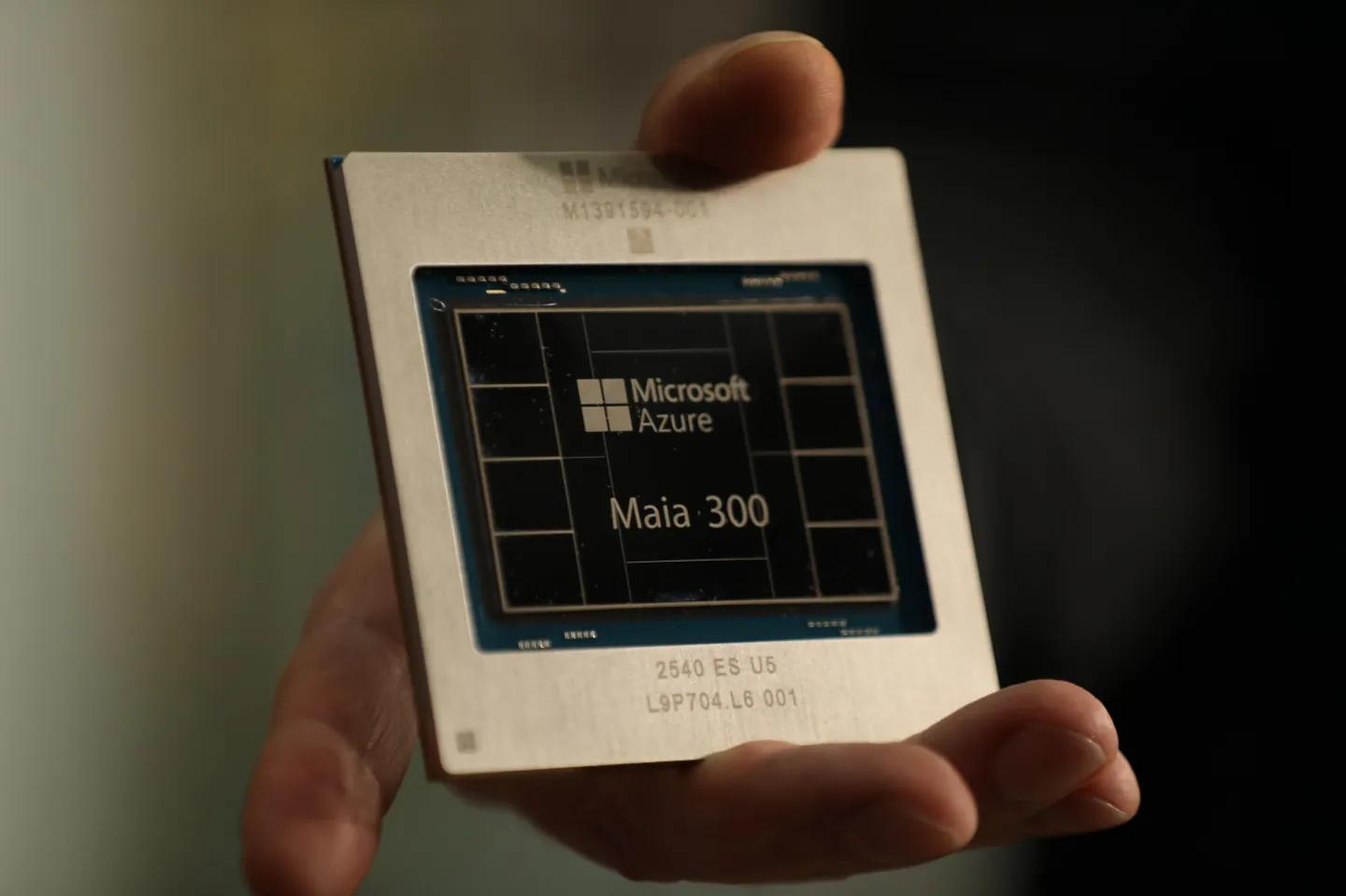
Microsoft just dropped its third-generation custom AI chip, the Azure Maia 300, and the message is unmistakable: the company is done renting Nvidia's GPUs for inference. Starting in 2027, Maia will become the primary inference system powering Copilot, GitHub Copilot, Microsoft Foundry, and everything else Redmond runs at scale — with deployments ramping to multiple gigawatts.
Scott Guthrie, Executive Vice President of Cloud + AI, announced the chip in an official blog post on October 12, 2026 at 06:00 (UTC-7), framing it as a fundamental shift in how Microsoft builds AI infrastructure.
What Maia 300 actually delivers
Maia 300 is an inference-first design, not a training chip. That distinction matters. Microsoft isn't trying to beat Nvidia at model training — it's trying to crush the economics of running models at scale.
The headline numbers:
| Metric | Maia 300 | Maia 200 | Leading GPU (est.) |
|---|---|---|---|
| Tokens per megawatt | +40% vs. GPU | — | Baseline |
| Rack-scale token throughput (96-accel) | Up to 7x Maia 200 | Baseline | — |
| HBM per rack | 27.6 TB | — | — |
| Aggregate HBM bandwidth per rack | 1.7 PB/s | — | — |
| Rack power envelope | 167 kW | — | — |
| Memory bandwidth per chip | 18.0 TB/s (HBM4) | — | — |
| TDP per chip | 950 W | — | — |
| Process node | TSMC N2P | — | — |
Source: Microsoft official blog, October 12, 2026 (UTC-7). GPU column is relative baseline; Microsoft did not name a specific competitor.
The architecture is built around a software-defined dataflow design — moving data efficiently rather than throwing raw compute at the problem. Eight HBM4 stacks per chip deliver 18 TB/s of peak bandwidth. A multi-chiplet design separates compute, memory controller, and I/O functions, with compute chiplets on TSMC's N2P node. Enhanced MXFP4 low-precision formats reduce memory and KV-cache requirements, enabling larger context windows within the same power budget.
Maia 200, the current generation, is already in production across the U.S., Europe, and Australia, serving Microsoft Copilot and delivering up to 1.7x more tokens per watt than leading GPU infrastructure for Teams and Copilot workloads. That real-world data directly informed Maia 300's design.
Why this matters
Microsoft is the largest buyer of AI compute in the world. Its Azure cloud runs OpenAI's models, its own MAI models, and a growing list of open-source families. Every token generated on an Nvidia H100 or B200 is a token that costs Microsoft margin — and a token that makes Nvidia richer.
The 40% tokens-per-megawatt claim is the number to watch. Inference is power-bound, not compute-bound, at scale. A 40% efficiency gain means Microsoft can serve 40% more Copilot queries from the same datacenter footprint, or run the same workloads at 40% lower cost. At gigawatt scale, that's billions of dollars in annual savings.
The 7x rack-throughput improvement over Maia 200 is even more aggressive. If that holds in production, a single Maia 300 rack replaces seven Maia 200 racks — reducing floor space, cooling infrastructure, and networking complexity by the same factor.
The competitive picture
Microsoft isn't alone in building custom silicon. Google's TPUs have powered Search and Gemini for years, and AWS Trainium and Inferentia are available to external customers. But Microsoft's approach differs in one key way: it has no plans to sell Maia capacity to third-party Azure customers. Maia is for Microsoft's own products only.
That's a strategic choice, not a limitation. By keeping Maia internal, Microsoft avoids competing with Nvidia in the cloud GPU rental market while still reducing its own dependency. Nvidia remains Azure's largest hardware supplier for training and for customer-facing GPU instances.
| Company | Custom Chip | External Availability | Primary Use |
|---|---|---|---|
| TPU v6/v7 | Yes (GCP) | Search, Gemini, customer workloads | |
| AWS | Trainium3 / Inferentia2 | Yes (AWS) | Customer inference + training |
| Microsoft | Maia 300 | No (internal only) | Copilot, GitHub Copilot, Foundry |
| Meta | MTIA v2 | No (internal only) | Ads ranking, recommendation |
Source: Company announcements, 2025–2026.
The critical question: can Microsoft execute?
Custom silicon is littered with failures. Meta's MTIA has had multiple delays. Amazon's Inferentia adoption has been slower than expected. The gap between a press release and production-scale deployment is where most custom chip programs die.
Microsoft has two advantages. First, Maia 200 is already in production — this isn't a paper architecture. The company has real workload data, real thermal profiles, and real software stacks running on its own silicon. Second, Microsoft controls the full stack: the models (via OpenAI partnership and MAI), the runtime, the orchestration layer, and the hardware. That co-design loop is what makes the 40% efficiency claim plausible.
The risk is software ecosystem. Nvidia's CUDA is decades old and deeply entrenched. Microsoft's Maia software stack — compilers, kernels, model support — has to be good enough that engineers don't notice they're not running on GPUs. The company says AI-assisted kernel optimization and software-defined dataflow are part of the answer, but we won't know until real workloads run on Maia 300 in 2027.
What to watch
The next 12 months will tell us whether Maia 300 is a real inflection point or another custom-silicon footnote. Key indicators:
- Q1 2027: First Maia 300 production deployments. Watch for Microsoft to disclose actual efficiency numbers vs. the 40% claim.
- Copilot cost per query: If Microsoft's gross margin on Copilot improves meaningfully in 2027, Maia is working.
- Nvidia data center revenue: Microsoft is one of Nvidia's top three customers. A meaningful shift to Maia would show up in Nvidia's guidance.
- OpenAI model support: Maia 300 runs OpenAI models today on Maia 200. If GPT-7 or future models are optimized for Maia first, the dependency shifts in the other direction.
Microsoft isn't leaving Nvidia. But it is building an exit ramp — and with Maia 300, that ramp just got a lot steeper.
No comments yet