Update: AI stocks bleed $2T as CoreWeave crisis spreads
What started as one company's bond market panic is now a sector-wide reckoning. On Friday, October 16, 2026 at 16:00 (UTC-4), the Nasdaq Composite closed down 2.15% at 26,140, capping its worst week since late June with a 4.5% decline. The Philadelphia Semiconductor Index fell for the eighth straight session — its longest losing streak since the 2008 financial crisis — wiping roughly $2 trillion off semiconductor market capitalization in eight trading days. CoreWeave, the neocloud at the center of the storm, lost 25% for the week and now trades more than 50% below its 2026 high.
This is no longer a CoreWeave story. It is a story about whether the entire AI infrastructure buildout can be financed at the speed the industry promised.
How we got here
On October 14, 2026 (UTC-4), CoreWeave's 2032 senior notes — originally issued with a 9.625% coupon — traded below 80 cents on the dollar, pushing yields above 15%. Its five-year credit default swaps touched 1,194.5 basis points intraday, a level that implies a greater than 60% probability of default within five years. The stock dropped 15% in a single session.
Two days later, the contagion had spread well beyond one ticker. Dell Technologies fell 4.6% on Friday alone and 22% for the week — its worst week since relisting in 2018. Nebius Group, another AI infrastructure play, sank more than 12%. ARM dropped nearly 7%, AMD roughly 6%, and Intel over 5%. Even Nvidia, CoreWeave's largest chip supplier and a ~10% shareholder, fell 1.4% to $214.13.
Goldman Sachs reported that hedge funds dumped AI stocks at the second-fastest pace in over a year, characterizing the move as a "tactical rotation" out of smaller AI names and into the Magnificent Seven or non-AI equities entirely.
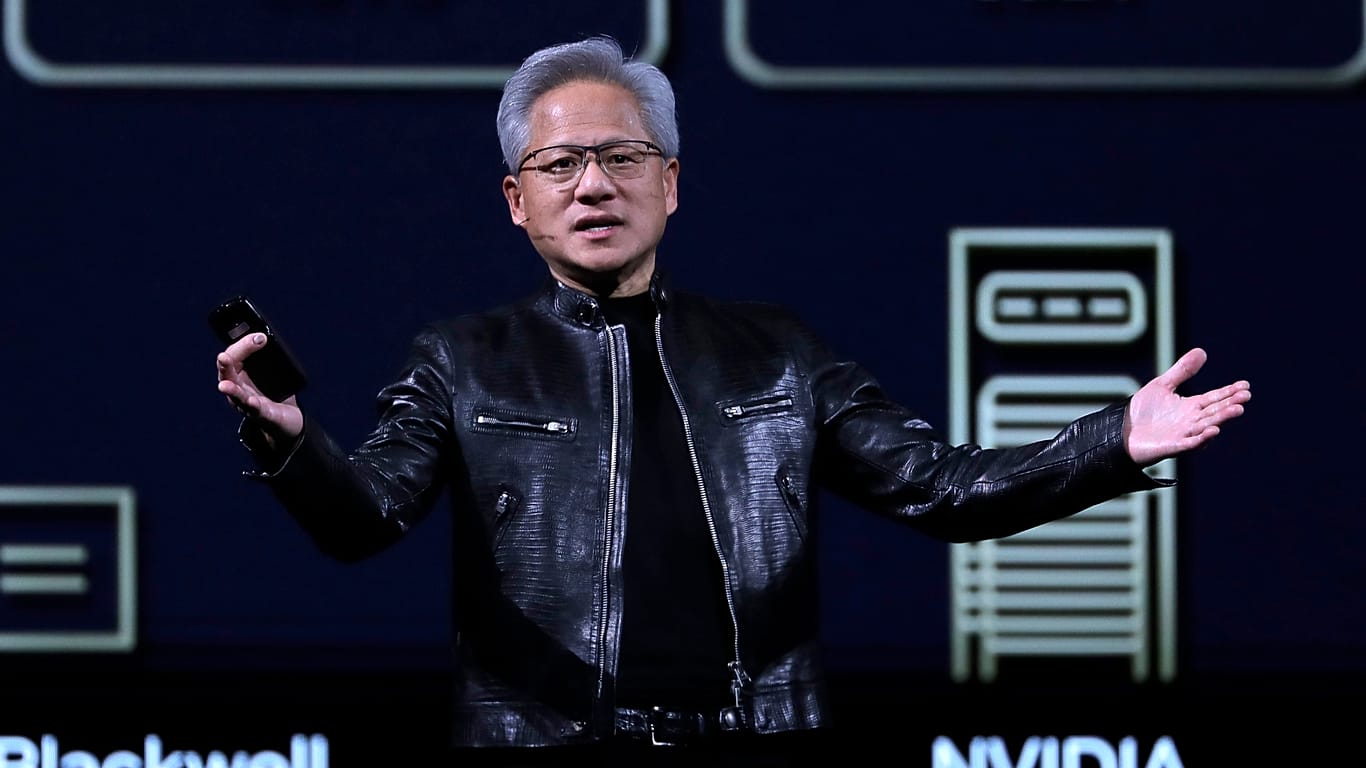
Jensen Huang says everything is fine. The bond market disagrees.
Speaking to Bloomberg at an event in Stockholm on October 15, 2026 (UTC+1), Nvidia CEO Jensen Huang offered a characteristically calm assessment: "I'm optimistic. Their cost of capital is actually decreasing." He added that CoreWeave's "strength is improving every day" and that he saw no need for Nvidia to provide a financial backstop.
The numbers tell a different story.
| Metric | Value | Source |
|---|---|---|
| CoreWeave total debt + operating leases | > $50 billion | Company filings, Motley Fool |
| 2032 senior notes yield | ~15% (from 9.625% coupon) | Trace bond data |
| 5-year CDS spread (intraday high) | 1,194.5 bps | The Next Web, DiarioBitcoin |
| Implied 5-year default probability | > 60% | CDS market pricing |
| Projected free cash flow 2026 | -$25 billion | Visible Alpha |
| Projected free cash flow 2027 | -$28 billion | Visible Alpha |
| Projected free cash flow 2028 | -$18 billion | Visible Alpha |
| Cash and equivalents (Q2 2026) | ~$6 billion | Company filings |
| Stock decline from 2026 high | > 50% | Nasdaq |
A company burning $25–28 billion per year in free cash flow with $6 billion on hand and $50 billion in debt does not have a "decreasing cost of capital" by any conventional measure. What it has is a chip supplier that cannot afford to let it fail. Nvidia's own 8-K reveals an obligation to purchase CoreWeave's residual unsold capacity through April 13, 2032, under an order form initially valued at $6.3 billion. That commitment — not CoreWeave's standalone creditworthiness — is what keeps the lights on.
Huang's reassurance helped the stock bounce intraday on Thursday, but by Friday's close the selling had resumed. The market is pricing in a restructuring, a rescue, or both.
Why it matters: the AI capex cycle just hit a wall
The CoreWeave crisis is forcing a fundamental repricing of how the AI industry funds itself. For two years, the playbook was simple: borrow heavily, buy Nvidia GPUs, sign long-term contracts with hyperscalers, and assume demand would always outpace supply. That model worked when interest rates were falling and AI revenue was accelerating. It breaks when the 10-year Treasury yield sits at 5.10% and investors start asking when — not whether — these companies will generate positive free cash flow.
The math is unforgiving. CoreWeave is projected to burn $71 billion in free cash flow between 2026 and 2028. To fund that, it needs continuous access to debt and equity markets. If its bonds trade at 15% yields, every new dollar of debt costs more than the gross margin on the GPU capacity it buys. The company becomes a wealth-destruction machine: borrowing at 15% to earn returns that, even in bull-case scenarios, are in the high single digits.
This is why the selloff spread to Dell, Super Micro, and the broader semiconductor complex. If neoclouds can't finance expansion, GPU demand forecasts get cut. If GPU demand gets cut, Nvidia's growth narrative — the one that supports a $5+ trillion market cap — comes under pressure. The $2 trillion in semiconductor market cap that vanished in eight days is the market collectively asking: what if the AI capex cycle was always a credit bubble in disguise?
The SpaceX wildcard
While CoreWeave burns cash, Elon Musk's SpaceX is quietly positioning to eat its lunch. Following its xAI merger and Cursor acquisition, SpaceX now operates Colossus data centers originally built for Grok training and is renting excess capacity to external customers. The numbers are striking:
| Customer | Monthly spend | Contract details |
|---|---|---|
| Anthropic | $1.25 billion | Capacity across SpaceX infrastructure |
| Google Cloud | $920 million | 110,000 Nvidia GPUs, starts October 2026, through June 2029 |
| Reflection AI | $150 million | Up to $6.3 billion lifetime value |
| Undisclosed (Sept 2026) | $1.11 billion | Revenue begins December 2026 |
| Total monthly | ~$3.4 billion | ~$41 billion annualized |
SpaceX ended Q2 2026 with roughly $100 billion in cash and equivalents against $39.4 billion in total debt. That balance sheet — combined with the fact that its AI infrastructure is cross-subsidized by launch and Starlink revenue — gives it a financing advantage no pure-play neocloud can match. If CoreWeave slows construction to preserve liquidity, SpaceX is the natural beneficiary.
The critical question nobody is asking
D.A. Davidson analyst Gil Luria, who previously called CoreWeave the "subprime tranche" of AI, warned on a podcast that if the AI financing boom cools, CoreWeave "could go to zero." That is an extreme outcome, but it highlights the real risk: the entire neocloud business model depends on the perpetual availability of cheap capital. When that capital dries up, the companies that survive will be those with diversified revenue, fortress balance sheets, or strategic patrons.
CBOE Global Markets senior VP JJ Kinahan offered a more measured take: "We're in a high-risk area, but this kind of credit pressure often leads to consolidation." That may be the most likely endgame — not a wave of bankruptcies, but a wave of acquisitions as stronger players (hyperscalers, SpaceX, even Nvidia itself) pick up distressed GPU capacity at pennies on the dollar.
What to watch next
The next three weeks will be decisive. Watch for:
- CoreWeave's Q3 earnings (expected early November) — if revenue guidance comes down or the company announces a financing round at punitive terms, the crisis deepens.
- Nvidia's Q3 earnings (expected November) — any downward revision to data center revenue guidance confirms that the neocloud distress is hitting the mother ship.
- Credit market access — if CoreWeave or its peers (Nebius, Lambda, Crusoe) cannot roll maturing debt at single-digit rates, the sector faces a liquidity crunch.
- SpaceX capacity deals — every new hyperscaler contract SpaceX signs is one less for CoreWeave.
- M&A activity — a hyperscaler or Nvidia acquiring a distressed neocloud would mark the bottom of the cycle.
The AI revolution is not over. But the era of borrowing unlimited money to build unlimited data centers — with no regard for when the cash flow turns positive — just ended. The companies that survive the next 12 months will be the ones that can finance their own growth, not the ones that tell the best story about demand.
No comments yet