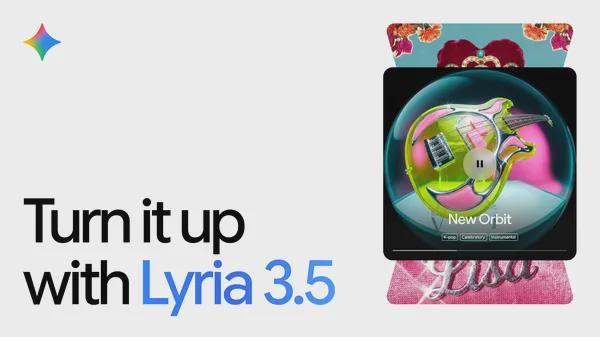
Google quietly dropped something big into Gemini on September 4, 2026 (UTC). Lyria 3.5, the company's best-sounding music generation model, is now available to every Gemini user globally — both in the app and through the Gemini API. No waitlist, no limited beta.
What's new
Lyria 3.5 first launched about a month ago in Google Flow Music, the company's dedicated AI music platform. Now it's been folded into Gemini proper, which means hundreds of millions of users can generate music without leaving the app.
In the Gemini app, users can:
- Pick or describe a genre, then choose vocal or instrumental
- Use new templates to jumpstart anything from background music to birthday tracks
- Choose between short clips and longer, full-length songs
The model generates 44.1 kHz stereo audio from text prompts or images. According to Google's developer documentation, updated September 4, 2026 (UTC), Lyria 3.5 produces structurally coherent tracks with vocals, timed lyrics, and full instrumental arrangements — verses, choruses, bridges, the whole thing.
Two models for developers
The Gemini API now exposes two Lyria models:
| Model | ID | Output |
|---|---|---|
| Lyria 3 Clip | lyria-3-clip-preview |
30-second clips for loops and previews |
| Lyria 3.5 | lyria-3.5 |
Full songs, several minutes long |
Both default to MP3 output, with Lyria 3.5 also supporting WAV. Developers can feed up to 10 images alongside a text prompt, and the model composes music based on the visual content. Everything runs through Google's Interactions API and carries a SynthID watermark that survives compression and resampling.
The API is in public preview as of September 3, 2026 (UTC), accessible through Google AI Studio, Vertex AI, and the Gemini API. Google hasn't published pricing for Lyria 3.5 yet.
Why this matters
AI music has been dominated by startups like Suno and Udio, which built massive user bases by letting anyone type a prompt and get a full song. Google has been playing catch-up — Lyria 3 launched in February 2026 (UTC) with 30-second clips, and Lyria 3 Pro followed in March. Lyria 3.5 is the first version that can genuinely compete on full-song quality.
Putting it directly into Gemini is the real move. Suno and Udio are standalone apps. Gemini is already on hundreds of millions of phones and desktops. A user who opens Gemini to write an email can now generate a soundtrack for their video in the same session. That distribution advantage is hard to beat.
The timing is also notable. A recent European court ruling against Suno over copyright training data has left the AI music startup space in flux. Google, with its licensing deals and SynthID watermarking, is positioning Lyria as the safer, more legitimate option for creators and brands.
Sources: Google Blog, Android Authority, Unite.AI, TNW, The Next Web
No comments yet